
Introduction
A soft starter is a device used to control the acceleration of an electric motor by gradually controlling the voltage applied to it. It helps reduce mechanical stress and electrical disturbances during motor startup.

Every motor requires a starter because, during starting, an induction motor draws a very high current due to the interaction between rotor winding flux and the rotating magnetic field. This high current can cause excessive heating and may damage the motor if not controlled.
When a motor reaches its rated speed, the stator may have already drawn current much higher than its rated value. To prevent overheating and damage, motor starters are used.
Methods of Motor Starting
Motor starting can be classified into the following three methods:
- Direct On Line (DOL) Starting: Full voltage is applied directly to the motor.
- Reduced Voltage Starting: Voltage is gradually applied using Star-Delta starters or Soft Starters.
- Part Winding Starting: Uses an autotransformer starter.
Definition of Soft Starting
Technically, a soft starter is any device that reduces the torque applied to an electric motor during starting. A soft starter typically uses solid-state devices such as thyristors (SCRs) to control the voltage supplied to the motor.
The torque developed by the motor is proportional to the square of the starting current, which itself is proportional to the applied voltage. Therefore, by reducing the applied voltage during startup, both the starting current and torque can be effectively controlled.
Types of Control in Soft Starter
There are two main types of control used in soft starters:
1. Open-Loop Control
In open-loop control, the starting voltage is gradually increased regardless of the motor speed or the current drawn.
- Two SCRs are connected back-to-back for each phase.
- Initially, the SCRs conduct with a delay of 180 degrees during each half cycle.
- The delay angle is gradually reduced until the full supply voltage is applied.
This method is also known as the Time Voltage Ramp System. Since it does not regulate motor acceleration based on feedback, it is less precise.
2. Closed-Loop Control
In closed-loop control, the starting voltage is adjusted based on monitored motor parameters such as current or speed.
If the current in any phase exceeds a preset value, the voltage ramp is temporarily halted. This ensures better control over motor acceleration and protection.
Main Components of a Soft Starter
1. Power Switches
Power switches such as SCRs are phase-controlled and connected back-to-back for each phase of a three-phase motor. These devices must be rated for at least three times the line voltage.
2. Control Logic
Control logic regulates the firing angle of SCRs by controlling the gate pulses. This is achieved using PID controllers, microcontrollers, or other electronic logic circuits.
Working of Soft Starter
An electronic soft starter system for a three-phase induction motor consists of comparators, ramp generators, opto-isolators, and SCRs.
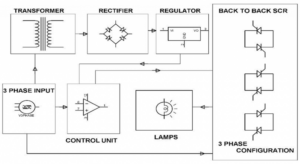
Block Diagram showing Electronic Soft Start System for 3 phase Induction Motor
- The comparator LM324 generates a level voltage using a capacitor charged and discharged through an NPN transistor.
- The voltage level changes due to capacitor charging and discharging.
- Another comparator LM339 compares the ramp voltage with the level voltage.
- The ramp voltage is produced by comparing pure DC voltage with pulsating DC voltage.
- This ramp signal controls the pulse width generated by the comparator.
- The pulse width decreases as the voltage level reduces.
- An opto-isolator transfers the inverted pulses to the SCR gates.
- As the pulse width increases, the SCR firing delay reduces.
By controlling the firing angle of the SCRs, the supply voltage applied to the motor is gradually increased, resulting in smooth acceleration and controlled torque.
This system operates as an open-loop control system, where the firing pulses depend on the ramp and level voltage relationship.
Advantages of Soft Starter
- Improved Efficiency: Uses solid-state switches with low on-state voltage drop.
- Controlled Startup: Smooth and jerk-free motor starting.
- Reduced Starting Current: Minimizes electrical stress on supply lines.
- Extended Motor Life: Reduces mechanical wear and thermal stress.
Applications of Soft Starter
- Induction motors
- Pumps and compressors
- Conveyors and elevators
- Fans and blowers
- Industrial automation systems
Conclusion
Soft starters play a crucial role in modern motor control by providing smooth acceleration, reducing electrical stress, and extending motor lifespan. They are widely used in industrial and commercial applications where controlled motor starting is essential.