
What is a Function Generator?
A function generator is a type of signal generator that produces electrical waveforms of common shapes. Unlike RF signal generators, which typically generate only sine waves, a function generator can produce a variety of repetitive waveforms.
A function generator can operate as a sine wave generator, square wave generator, triangular wave generator, or pulse generator. It is widely used in electronic testing, development, and troubleshooting.

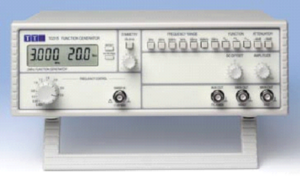
In a typical function generator, the waveform characteristics such as frequency, amplitude, duty cycle, and DC offset can be adjusted. However, it can only generate the waveforms that are built into the instrument. In addition to waveform generation, a function generator can add a DC offset to the output signal, which is extremely useful in many testing applications.
Most basic function generators operate at relatively low frequencies, typically up to 100 kHz. Advanced and more expensive models can operate at higher frequencies, up to 20 MHz or 30 MHz.
Function Generator Capabilities
The function generator gets its name from its ability to generate different mathematical functions or waveform shapes. The most common waveforms generated are listed below.
Sine Wave
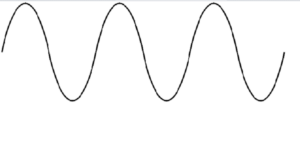
A sine wave is a smooth periodic waveform that oscillates between two voltage levels. Function generators are commonly used as sine wave generators in testing applications, especially for amplifier and filter testing.
Square Wave
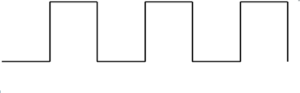
A square wave alternates between high and low voltage levels with fast transitions. When used as a square wave generator, the function generator provides a basic digital waveform useful for testing logic circuits.
Pulse Wave
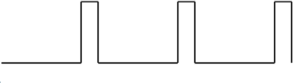
A pulse waveform is similar to a square wave, but with an unequal high-to-low time ratio. Pulse signals are widely used in digital electronics and timing applications.
Triangular Wave
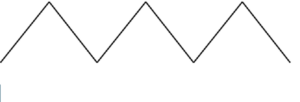
A triangular wave moves linearly between its maximum and minimum voltage levels. This waveform is commonly generated using an operational amplifier acting as an integrator. Triangular waveforms are frequently used in amplifier testing because distortion and clipping are easier to detect than with sine waves.
Sawtooth Wave
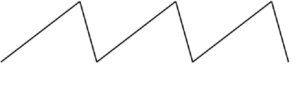
A sawtooth waveform is a variation of the triangular wave where the rise time differs from the fall time. It is generated by altering the charge and discharge rates of the integrator circuit. These fundamental waveforms satisfy most electronic testing requirements. When specialized waveforms are required, an arbitrary waveform generator is used.
Function Generator Controls
In addition to waveform selection, function generators include several control options:
- Frequency Control: Adjusts the repetition rate of the waveform.
- Waveform Selection: Allows selection of sine, square, or triangular waves.
- DC Offset: Shifts the average voltage level of the signal.
- Duty Cycle: Adjusts the ratio of high-to-low time in square and pulse waveforms.
Function Generator Usage
Function generators are commonly used in electronics development, manufacturing testing, and service departments. They offer a flexible and convenient way to generate test signals. Although function generators can generate low-frequency RF signals, dedicated RF signal generators are preferred for high-frequency applications.
Function generators are also not ideal for high-precision audio testing because the sine wave distortion level is typically around 1%, which may be unacceptable for some audio measurements. Some modern function generators allow the output signal to be phase-locked to an external reference when high frequency stability is required.
Types of Function Generators
Bench Top Function Generator
This is the most common type used in laboratories. It includes a power supply, control panel, display, and output connectors in a single enclosure.
Rack-Based Function Generator
Rack-based generators are used in automated test systems such as PXI platforms. They allow integration with other test instruments in a modular setup.
USB Function Generator
USB function generators connect directly to a computer and rely on software for control. They are compact, cost-effective, and save bench space.
Computer-Based Function Generator
In this approach, waveform generation is performed by software, and the signal is output through the computer’s sound card or a digital interface. While inexpensive, accuracy and output protection are limited.
Conclusion
Function generators are versatile and easy-to-use test instruments available in both analogue and digital designs. Analogue function generators typically use operational amplifiers, while digital versions rely on direct digital synthesis techniques. Due to their affordability and flexibility, function generators are essential tools in electronic laboratories and testing environments.