
Introduction to Dip Meter
A dip meter, also known as a grid dip oscillator (GDO), is a simple but effective RF test instrument used to determine various parameters of radio frequency circuits and components.
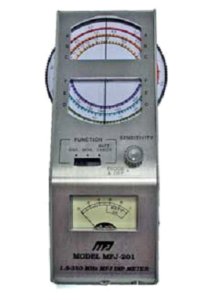

Earlier versions of this instrument used vacuum tubes or thermionic valves, which is why the name “grid dip oscillator” was used. With the introduction of semiconductor devices, the instrument is now commonly called a dip meter, gate-dip meter, or simply a dipper.
A dip meter can measure a test circuit without direct electrical connection. The coil of the dip meter only needs to be placed close to the circuit under test. Because of its ease of use, it was widely used for constructing, repairing, and adjusting radios, televisions, and other RF equipment.
What is a Dip Meter?
A dip meter is an instrument that contains an oscillator which can be tuned over a wide frequency range. Different frequency ranges are selected using external plug-in coils.
The operation of a dip meter is based on the principle that when the tuned circuit of an oscillator is placed near another resonant circuit, the oscillator current decreases when both circuits are tuned to the same resonant frequency.
The resonant frequency of the external circuit is indicated by the center point of the dip observed on the meter scale. By placing the dip meter near a tuned circuit, the resonant frequency of almost any circuit or antenna can be determined. Thus, a dip meter is essentially a calibrated variable-frequency oscillator in which the oscillator current is monitored.
Dip Meter as an Absorption Wavemeter
Apart from acting as an oscillator, most dip meters can also operate as an absorption wavemeter by turning off the oscillator. In this mode, the dip meter can detect strong RF signals, such as the field near a transmitter or feeder carrying RF power. It is useful for checking the frequency band of a transmission.
Grid Dip Oscillator Circuit Operation
When the coil of the grid dip oscillator is placed near a resonant circuit, some of the energy from the oscillator is transferred to the external circuit. When the oscillator frequency matches the resonant frequency of the external circuit, the coupling between the two circuits becomes maximum.
Under this condition, the external circuit absorbs energy from the oscillator, causing the amplitude of oscillation to decrease. Since the meter in the dip oscillator monitors the current drawn by the oscillator, the current drops when resonance occurs.
This drop in current is observed as a “dip” on the meter. The frequency at the lowest point of the dip corresponds to the resonant frequency of the circuit under test. An important advantage of this method is that the components do not need to be powered or removed from the circuit during testing.
Advantages of Dip Meter
Simplicity
The grid dip oscillator has a simple circuit design, making it easy to operate and maintain.
Versatility
It can be used for a variety of RF measurements, including resonant frequency detection and signal presence.
Low Cost
Dip meters are relatively inexpensive compared to other RF test instruments, making them accessible to hobbyists and radio amateurs.
No Direct Connection Required
The instrument only needs its coil placed near the tuned circuit. No direct electrical connection is required, which simplifies testing.
Disadvantages of Dip Meter
Low Accuracy
Due to its simple design, the dip meter provides only approximate measurements and is not highly accurate.
Free-Running Oscillator
The oscillator in a dip meter is free-running and affected by component tolerances, reducing measurement precision compared to modern digital instruments.
Coupling Effects
When the oscillator circuit is coupled to an external tuned circuit, the oscillator frequency may shift slightly, causing additional inaccuracy.
Conclusion
The dip meter or grid dip oscillator is a simple, versatile, and low-cost RF test instrument. Although it is not very accurate, it is extremely useful for quick checks and basic measurements when its limitations are understood.