
Introduction
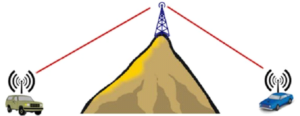

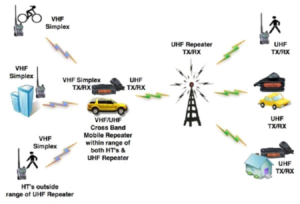
A repeater is a radio station that automatically receives an incoming signal and simultaneously retransmits it over a larger area. Repeaters are effective because they are usually located at high altitudes, such as mountains or tall towers, and operate at higher power than typical handheld or mobile ham radios. As a result, they extend the communication range far beyond what portable radios can normally achieve.
Amateur Radio Repeater Basics
A ham radio repeater is essentially a relay station that receives a signal on one frequency and retransmits it on a different frequency. Although this may seem simple, repeater stations include several automatically controlled functions to ensure efficient operation and to prevent unnecessary interference.
- When a repeater is not in use, it does not transmit. This saves power and reduces interference.
- Repeaters are designed so that spurious signals and noise do not cause unwanted transmissions.
- A valid signal must be present on the repeater’s input frequency for it to activate.
The incoming signal must:
- Be strong enough for retransmission
- Include a tone indicating that the station wants the signal repeated
There are two common methods for accessing a repeater:
- An audio tone burst at the beginning of each transmission
- CTCSS (Continuous Tone-Coded Squelch System), a sub-audible tone system
When the repeater is activated, the audio from the incoming signal is retransmitted on the output frequency. If the signal becomes too weak or noisy, the repeater may stop retransmitting it.
Many repeaters also include a timeout feature. This monitors the length of a transmission, and if it exceeds a set limit, the repeater stops retransmitting. This prevents users from occupying the repeater for too long and allows others to use it. After a transmission ends, the repeater detects the absence of the input signal. Many repeaters then transmit a short Morse code character—commonly the letter “K”—to invite the next station to transmit.
Once a contact is complete and no signals are detected, the repeater shuts down and must be reactivated for further communication.
Amateur Radio Repeater Terminology
Input Frequency
The frequency on which the repeater receives signals. Your radio must transmit on this frequency to access the repeater.
Output Frequency
The frequency on which the repeater retransmits signals. This is the frequency you listen to.
Offset
The difference between the repeater’s output and input frequencies.
For example, if a repeater transmits on 145.700 MHz and receives on 145.100 MHz, the offset is:
145.700 − 145.100 = 600 kHz
CTCSS Tone
CTCSS is a sub-audible access tone used by most repeaters. Each repeater requires a specific tone, and your radio must transmit this tone for the repeater to activate.
You must program your radio to:
- Switch from output to input frequency when transmitting
- Send the correct CTCSS tone
Once programmed correctly, save the settings in your radio memory for easy use.
Other Considerations
Over-Deviation
Sending excessive audio volume can cause over-deviation, resulting in distorted or unreadable transmissions. To reduce this risk:
- Set the bandwidth to Narrow instead of Wide for 2-meter repeaters
- Avoid setting the microphone gain too high
- Do not talk too close to the microphone or shout
Using a Repeater
Before using a repeater, it is advisable to listen to local activity and learn the operating etiquette.
Calling Procedure
Calling “CQ” on a repeater is generally discouraged. Instead, say:
“M6ABC listening for any calls.”
Mobile Priority
Repeaters are mainly intended for mobile communication. Base station users should give priority to mobile stations and leave pauses between transmissions.
Joining a Conversation
- Wait for a pause between transmissions.
- Announce your callsign.
- The next station will invite you to join.
The word “break” indicates a priority message. You may hear:
- “Station acknowledged”
- “Break acknowledged”
This means your request has been heard and you will be invited to speak shortly.
Timeout
Most repeaters include a timeout feature to prevent long transmissions. Some repeaters have a timeout of only 90 seconds to encourage shorter messages.
The “K” Signal
When a user finishes speaking, the repeater may transmit the Morse code letter “K” (dah-di-dah). This indicates that the timeout timer has reset. It is best to wait for this signal before transmitting again.
Conclusion
Amateur radio repeaters play an important role in extending communication range and improving signal reliability. Understanding repeater terminology, proper programming, and operating etiquette ensures smooth and efficient communication for all users.