
Introduction
Meteor Burst Communication (MBC), also known as meteor scatter communication, is a radio propagation method that utilizes the ionized trails of meteors as they enter the Earth’s atmosphere. These ionized trails create temporary paths that allow radio signals to travel over long distances, typically up to 2,250 kilometers (1,400 miles).
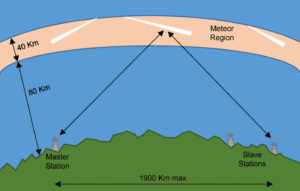

In this communication method, radio waves can experience either forward scatter or backscatter. The first major attempt to use meteor scatter for communication was the JANET project, conducted by the Canadian Defense Research Board in the early 1950s.
How Meteor Burst Communication Works
A typical Meteor Burst Communication (MBC) system consists of a master station and one or more receiving stations.
- The master station continuously transmits a probing signal into the atmosphere.
- Receiving stations wait and listen for reflections from meteor trails.
- When a meteor enters the atmosphere, it creates an ionized trail that briefly reflects radio signals.
These reflections last only for a short duration, so communication occurs in bursts rather than continuously.
Advantages of Meteor Scatter Communication
- Highly reliable: Meteor trails cannot be destroyed or disrupted by human activity.
- Secure communication: The signal footprint is small, making eavesdropping difficult unless the attacker is very close to the receiving station.
- Independent of infrastructure: Unlike satellites or cables, meteor scatter does not rely on physical systems that can fail.
Meteor Scatter in Ham Radio
Meteor scatter communication is quite different from traditional ham radio communication. Since signal paths are short-lived, special techniques and protocols are required. A single meteor trail may only support part of a communication exchange. Therefore, a complete contact often requires multiple meteor trails over a period of time.
Transmission Modes
Various transmission modes are used in meteor scatter communication:
- High-speed Morse code (historically popular in Europe)
- Transmission speeds of up to 800 words per minute
- Pre-recorded Morse signals using tape recorders (in earlier systems)
- Modern digital modes such as WSJT
Key System Requirements
1. Transmitter Power
A moderate to high level of power is usually required. While lower power may work at 50 MHz, frequencies like 144 MHz typically require around 100 watts or more at the antenna feed point (depending on licensing regulations).
2. Antenna Gain
Antenna gain requirements vary by frequency:
- Lower gain is sufficient at 50 MHz
- At 144 MHz, gains of 10–15 dB are recommended
- 13 to 17 element beam antennas are commonly used
Higher gain antennas may reduce the area over which meteor reflections can be detected, so a balance is necessary.
3. System Noise Figure
The overall system noise figure should be low, typically around 2.5 db. Losses in cables can degrade performance, so low-loss coaxial feeders are essential. Masthead pre-amplifiers are often used to boost signals before cable losses occur. However, excessive gain can overload the receiver and reduce performance.
4. Frequency Stability
Accurate frequency control is important:
- ±500 Hz tolerance for Morse code
- ±200 Hz tolerance for SSB
Modern transceivers generally provide sufficient stability, but dial readings may not always reflect actual signal accuracy.
5. Computer Support
Modern meteor scatter communication relies heavily on computers. Specialized software and interfaces are required to operate digital modes and manage communication effectively.
Conclusion
Meteor scatter communication is a unique and reliable method of long-distance communication that leverages natural atmospheric phenomena. Although it requires specialized equipment and techniques, it remains an important mode for both military and amateur radio applications.