

Introduction
An analog (analogue) multimeter is a reliable and widely used measuring instrument in the electronics testing industry. It has been in use for many years and is sometimes referred to as a VOA meter because it measures volts, ohms, and amps.
Analog multimeters are extremely versatile and can detect a wide range of faults in electronic circuits. Although digital multimeters (DMMs) are more common today, analog multimeters are still used in laboratories, workshops, and homes.
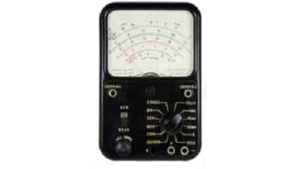
Typical analogue multimeter
Analog test meters provide readings that are sufficiently accurate for most practical purposes. While they require slightly different operating skills compared to digital meters, they remain simple and effective to use.
What is an Analog Test Meter?
Analog multimeters, also known as test meters, are measurement instruments that use a moving coil meter. The display consists of a pointer or needle that deflects over a calibrated scale to indicate the measured value.
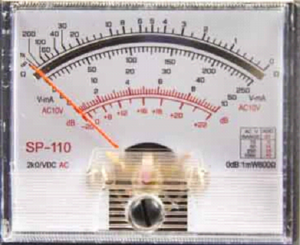
The scale on an analogue multimeter
The basic meter movement deflects from its rest position as the measured quantity increases. Such meters were widely used in laboratories from the 1970s to the 1990s before digital technology largely replaced analog techniques.
Scale and Construction of an Analog Multimeter
A typical analog multimeter uses a single meter movement along with series and parallel resistors to provide multiple measurement ranges. A large rotary switch, usually located at the center of the front panel, is used to select the required measurement function and range.
Multiple probe terminals are provided:
- Common (COM) terminal
- Standard measurement terminal labeled as Volts, Amps, or Ohms
- High-current terminal such as 10A for large current measurements
Parallax Error in Analog Multimeters
Parallax error is a common source of reading error in analog meters. It occurs when the scale is viewed from an angle rather than directly in front.
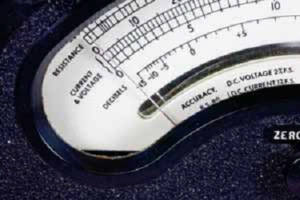
Parallax error when reading a scale at an angle
To avoid this error, the eye should be positioned perpendicular to the meter scale. Viewing from the side can cause incorrect readings. Some high-quality meters, such as AVO meters, include a mirror behind the scale. When the needle aligns with its reflection, the observer knows the meter is being viewed correctly.
Analog Multimeter Ranges
Analog multimeters operate on the principle of Full Scale Deflection (FSD). This represents the maximum value that can be measured on a particular range. For best accuracy, readings should ideally fall between one-quarter and full-scale deflection. Therefore, analog meters provide several closely spaced ranges.
Typical Measurement Ranges
- DC Voltage: 2.5V, 10V, 25V, 100V, 250V, 1000V
- AC Voltage: 10V, 25V, 100V, 250V, 1000V
- DC Current: 50µA, 1mA, 10mA, 100mA
- Resistance: R, 100R, 10kR
Advantages of Analog Multimeter
- Continuous needle movement makes it easy to observe trends and fluctuations
- Low cost compared to digital multimeters
- Wide availability despite the popularity of digital meters
- Quick visual estimation of readings at a glance
Disadvantages of Analog Multimeter
- Multiple scales can be confusing and prone to reading errors
- Lower input resistance compared to digital multimeters
- No auto-polarity feature; incorrect lead connection may damage the meter
- Less accurate than digital multimeters, though sufficient for many applications
Conclusion
Although digital multimeters dominate modern electronics, the analog multimeter remains a valuable tool. Its ability to show real-time variations and trends makes it particularly useful in troubleshooting and educational environments. With proper handling and correct reading techniques, analog multimeters continue to provide reliable and meaningful measurements.