
The Binary Number System and Decimal Number System are fundamental concepts in digital electronics and computer science. Since computers operate using binary (0 and 1), understanding number system conversion is essential for students and programmers.
What is a Binary Number System?
The binary number system is a base-2 numbering system that uses only two digits: 0 and 1.
- Each binary digit is called a Bit.
- A group of 4 bits is called a Nibble.
- A group of 8 bits is called a Byte.
Binary numbers are represented as sequences of 0s and 1s. Modern computers use binary numbers for data storage, processing, and communication.
What is a Decimal Number System?
The decimal number system is also known as the Hindu-Arabic number system. It is a base-10 system because it uses ten digits:
0, 1, 2, 3, 4, 5, 6, 7, 8, 9
It is a positional number system where each digit has a place value based on powers of 10.
Example:
1345 = (1 × 10³) + (3 × 10²) + (4 × 10¹) + (5 × 10⁰)
     = 1000 + 300 + 40 + 5
     = 1345
Use of Binary Number System
The foundation of the binary system in digital electronics was influenced by:
- George Boole – Developed Boolean Algebra in 1847.
- Claude Shannon – Applied Boolean Algebra to electrical circuits in 1937.
Today, binary numbers are used in:
- Computers
- Digital Logic Circuits
- Communication Systems
- Data Storage
Decimal to Binary Conversion Method
To convert a decimal number into binary:
- Divide the decimal number by 2.
- Write down the remainder (0 or 1).
- Divide the quotient again by 2.
- Repeat the process until the quotient becomes 0.
- Read the remainders from bottom to top.
The first remainder is the LSB (Least Significant Bit) and the last remainder is the MSB (Most Significant Bit).
Example: Convert 65 (Decimal) to Binary
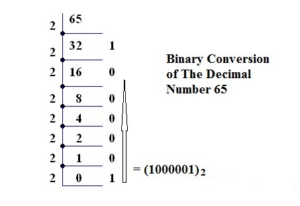
65 ÷ 2 = 32 remainder 1
32 ÷ 2 = 16 remainder 0
16 ÷ 2 = 8  remainder 0
8  ÷ 2 = 4  remainder 0
4  ÷ 2 = 2  remainder 0
2  ÷ 2 = 1  remainder 0
1  ÷ 2 = 0  remainder 1
Reading from bottom to top:
65₁₀ = 1000001₂
Binary to Decimal Conversion Method
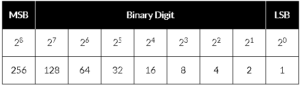
The binary number system is also positional, but it uses base 2. Therefore, place values are powers of 2.
To convert binary to decimal:
- Write the powers of 2 from right to left.
- Multiply each binary digit by its corresponding power of 2.
- Add all the results.
Example: Convert 1101₂ to Decimal
1101₂ = (1 × 2³) + (1 × 2²) + (0 × 2¹) + (1 × 2⁰)
      = (1 × 8) + (1 × 4) + (0 × 2) + (1 × 1)
      = 8 + 4 + 0 + 1
      = 13₁₀
Therefore, 1101₂ = 13₁₀
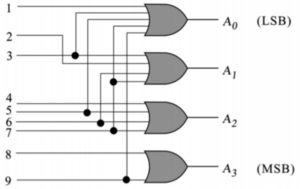
Decimal to BCD Encoder
An Encoder is a combinational logic circuit that converts data from one format to another.
A Decimal to BCD (Binary Coded Decimal) Encoder converts decimal numbers (0–9) into their 4-bit binary equivalent.
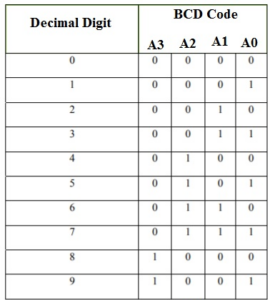
For example:
- 0 → 0000
- 1 → 0001
- 2 → 0010
- 9 → 1001
The encoder uses OR gates to generate logical equations:
- A3 = 8 + 9
- A2 = 4 + 5 + 6 + 7
- A1 = 2 + 3 + 6 + 7
- A0 = 1 + 3 + 5 + 7 + 9
The reverse operation is performed by a Decoder.
Conclusion
Binary and decimal number systems are essential in computer science and digital electronics. While humans use decimal numbers for everyday calculations, computers process and store all information internally in binary form. Understanding binary to decimal and decimal to binary conversion is crucial for programmers, engineers, and students.