
Introduction
Multivibrator circuits are classified into three types: monostable, astable, and bistable. A bistable multivibrator operates like a pulse detector. When an electronic trigger is applied to the circuit, the output switches between two stable states: high and low.
Unlike an astable multivibrator, this switching does not produce continuous oscillations. Instead, the circuit remains in one stable state until an external trigger changes it. The switching threshold depends on the passive components used in the regenerative feedback loop between the two transistors.
The transistors used in the circuit limit the visible switching time at the output. When the circuit is triggered, a small propagation delay (typically around 5 ns in bipolar transistors) occurs before the output changes state. Although bipolar transistors have relatively slow rise times compared to other transistor families, bistable multivibrators still provide a simple and cost-effective solution for accurate triggering applications.
Construction of Bistable Multivibrator
Two identical transistors Q1 and Q2 are connected in a feedback configuration using load resistors RL1 and RL2. Base resistors R3 and R4 are connected to a common negative supply (–VBB).
Feedback resistors R1 and R2 are bypassed using commutating capacitors C1 and C2. These capacitors are also called speed-up capacitors because they reduce the transition time required for switching between the two transistors.
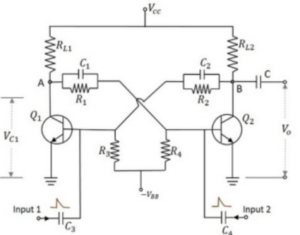
Capacitor C3 provides a trigger input to the base of transistor Q1, while capacitor C4 provides a trigger to the base of transistor Q2. This arrangement forms a self-biased bistable multivibrator with two stable states.
Working of Bistable Multivibrator
Let us assume that the SPDT switch is initially set to position 1, grounding the base of transistor Q1. As a result, Q1 turns OFF (cut-off region) and its collector remains at VCC, producing a high output at terminal O1.
This high voltage forward-biases the base-emitter junction of Q2, causing it to turn ON (saturation region). The collector of Q2 is pulled to ground through resistor RC2, resulting in a low output at O2.
This state remains unchanged until an external trigger is applied. When the switch is moved to position 2, the base of Q2 is grounded, turning it OFF. Now the collector of Q2 rises to VCC, giving a high output at O2.
Through resistor R2, this high voltage at the collector of Q2 forward-biases the base of Q1, turning it ON (saturation). Consequently, the collector of Q1 is pulled to ground, giving a low output at O1. This new state is maintained until another trigger is applied.
Important Characteristics
- Bistable circuits are not self-triggered; they require an external trigger to change state.
- The outputs at O1 and O2 are always complementary.
- Triggering can be asymmetric or symmetrical.
- Symmetrical triggering is of three types: base triggering, collector triggering, and hybrid triggering.
Bistable multivibrators are commonly used in memory elements, timing circuits, frequency dividers, toggle switches, counters, shift registers, relay controllers, and communication systems.
Advantages of Bistable Multivibrator
- Stores the previous output state until externally changed.
- Simple and easy-to-implement circuit design.
- Maintains clear and perfect logic levels.
- Helps in avoiding metastability issues.
- Better pulse conditioning compared to standard comparators.
Disadvantages of Bistable Multivibrator
- Requires two separate trigger pulses for operation.
- Slightly more expensive than other multivibrators.
- Slow input signals result in slower output transitions.
- Noisy input signals lead to noisy output signals.
Applications of Bistable Multivibrator
- Used in storage devices and binary counters.
- Used in frequency divider circuits.
- Used for generating clock pulses.
- Used in relay control circuits.
- Used as an electronic toggle switch.
Conclusion
A bistable multivibrator is a fundamental electronic circuit that can remain in one of two stable states until externally triggered. Its simplicity, reliability, and ability to store data make it an essential building block in digital electronics, memory units, and control systems.