

Introduction
Transformers are one of the most significant developments in the electrical and industrial fields. They offer numerous benefits and are widely used across various applications. One such advanced instrument transformer is the Capacitive Voltage Transformer (CVT).
CVTs have been in use for several decades and are especially suitable for high-voltage transmission systems. Although they provide economic and structural advantages, they also have certain limitations related to harmonic distortion and accuracy. This article explains the working principle, construction, phasor diagram, advantages, limitations, and applications of CVTs.
What is a Capacitive Voltage Transformer?
A Capacitive Voltage Transformer is a step-down instrument transformer that converts very high voltages into low, measurable values using capacitive voltage division. It performs a function similar to that of a potential transformer (PT) but is more economical for high-voltage systems. CVTs reduce transmission-level voltages to standardized low values for the purposes of metering, protection, and control of high-voltage power systems.
In high-voltage transmission lines, direct measurement of voltage is impractical. Conventional potential transformers become bulky and expensive beyond certain voltage levels. To overcome this problem, CVTs are used, especially for voltages above 73 kV.
Purpose of Capacitive Voltage Transformer
For voltage levels above 100 kV, highly insulated transformers are required, which significantly increase cost and installation complexity. CVTs provide a cost-effective alternative by replacing large inductive voltage transformers. Although CVTs are less accurate than inductive PTs, their lower cost, compact size, and suitability for high-voltage systems make them ideal for transmission applications.
Working Principle of Capacitive Voltage Transformer
A CVT mainly consists of the following three sections:
- Capacitive Potential Divider
- Inductive Element (Tuning Reactor)
- Auxiliary Transformer
The capacitive potential divider is formed by two capacitors C1 and C2 connected in series between the transmission line and ground. This divider reduces the high voltage to a lower value. The reduced voltage from the divider is fed into the auxiliary transformer, which further steps down the voltage to a measurable level suitable for meters and protective relays.
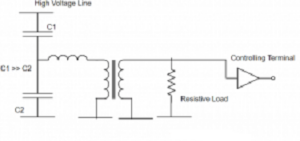
The capacitor closer to the ground has a higher capacitance than the capacitor near the transmission line. This ensures that most of the voltage drop occurs across the upper capacitor. Due to the capacitive nature of the divider, a phase shift occurs. To compensate for this phase shift, an inductive element is connected in series with the auxiliary transformer.
The inductance value is given by:
L = 1 / [ω² (C1 + C2)]
This inductance compensates for voltage drop and phase shift. However, perfect compensation is not always possible due to losses. The voltage transformation ratio of a CVT is:
Vo/Vi = (C2 / (C1 + C2)) × (N2 / N1)
Since C1 is greater than C2, the output voltage is significantly reduced.
CVT Phasor Diagram
To understand the phasor diagram, the equivalent circuit of the CVT must be considered. A matching transformer is placed between capacitor C2 and the measuring instrument. The tuning reactor is selected so that the circuit operates under resonance conditions, which occurs
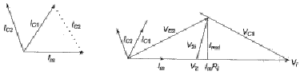
when:
ω (L + Lt) = 1 / (C1 + C2)
Here, L is the tuning choke inductance and Lt is the transformer’s equivalent inductance.
Under resonance, the circuit behaves like a resistive circuit, and both input and output voltages remain in phase, improving measurement accuracy.
Difference Between CVT and Potential Transformer
| Capacitive Voltage Transformer | Potential Transformer |
|---|---|
| Uses series-connected capacitors for voltage division | Uses inductive step-down principle |
| Suitable for voltages above 73 kV | Generally used up to 12 kV |
| Lightweight and compact | Bulky and heavy at high voltages |
| Economical for high-voltage systems | More expensive for high voltages |
| Can be used for power line carrier communication | Not suitable for carrier communication |
Advantages of Capacitive Voltage Transformer
- Lower cost compared to inductive potential transformers
- Compact and lightweight construction
- Requires less insulation
- Can be used for power line carrier communication
- Simple design and installation
Applications of Capacitive Voltage Transformer
- High and ultra-high voltage transmission systems
- Voltage measurement and metering
- Protective relay systems
- Automatic control and monitoring devices
- Power line carrier communication systems
Due to their economic advantages and suitability for very high voltages, capacitive voltage transformers are widely used in modern power transmission networks.