
Introduction
Electric fans are widely used in homes, offices, factories, automobiles, computers, and trains. Based on the type of power supply, fans are classified into three categories: AC fans, DC fans, and AC/DC fans. There are various types of electric fans such as ceiling fans, table fans, pedestal fans, and exhaust fans. Among these, ceiling fans are most commonly used in bedrooms, living rooms, and kitchens.
Ceiling fans are generally specified by their blade span size. The standard sizes of ceiling fans are 36 inches (900 mm), 48 inches (1200 mm), and 52 inches (1300 mm). To ensure smooth rotation and proper starting of the fan motor, a capacitor is used, which is known as a Fan Capacitor.
What is a Fan Capacitor?
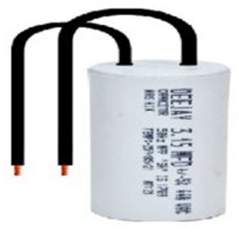
A fan capacitor is a type of non-polarized AC capacitor used in ceiling fans. It plays a crucial role in starting and running the fan motor smoothly. The main electrical components of a ceiling fan include the stator, rotor, capacitor, and regulator. Among these components, the capacitor is essential because it creates a phase difference between the windings, which helps the motor to start and rotate continuously.
Fan Capacitor Specifications
- Mounting type: Through-hole
- Capacitance range: 1.5 MFD to 4 MFD
- Voltage rating: 440 VAC
- Frequency: 50 Hz
- Number of phases: Single phase
- Tolerance: ±5%
- Shape: Cylindrical
- Diameter: 27 mm
- Size: 27 × 52 mm
- Operating temperature: –25°C to +85°C
- Terminals: Wire leads
Working of a Fan Capacitor
When a ceiling fan is switched ON, current flows through the motor windings. However, a single-phase AC supply alone cannot produce a rotating magnetic field. The fan capacitor helps by creating a phase difference between the starting winding and the running winding. This phase shift produces the required starting torque, allowing the motor to rotate smoothly. Most ceiling fans use either two capacitors (a start capacitor and a run capacitor) or a single capacitor that performs both functions.
Types of Fan Capacitors
Start Capacitor:
- Provides high starting torque
- Used only during motor startup
- Usually larger in size
Run Capacitor:
- Rated for continuous operation
- Smaller in size
- Self-healing and non-polarized
- Can be connected in any direction
How Does a Fan Capacitor Control Fan Speed?
When the fan is turned ON, the capacitor charges and stores electrical energy. It then releases this energy to the motor windings, increasing the current flow. This increased current produces higher torque, which makes the motor rotate faster. By changing the effective capacitance using a regulator, the speed of the fan can be controlled.
Fan Capacitor Connection Diagram Explanation
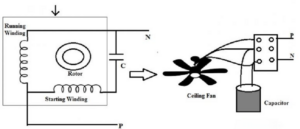
A ceiling fan generally consists of two windings: a running winding and a starting winding. The capacitor is connected in series with the starting winding, while the running winding is connected directly to the power supply.
Identifying Fan Windings Using Resistance
Typical resistance measurements between fan wires are:
- Red and Black: 200 ohms
- Red and Blue: 210 ohms
- Blue and Black: 500 ohms
From these values:
- Red wire is the common terminal
- Blue wire is the starting winding (higher resistance)
- Black wire is the running winding (lower resistance)
The capacitor is connected between the starting and running windings.
How Does a Fan Capacitor Work?
Without a capacitor, both the starting and running windings are in phase, which does not create a rotating magnetic field. As a result, the fan cannot start. When a capacitor is connected, it shifts the phase of current in the starting winding by approximately 90 degrees. This phase shift produces a rotating magnetic field, allowing the motor to start and run smoothly.
Features of a Fan Capacitor
- No capacitance loss
- Long service life
- Low dissipation factor
- Self-healing property
- High insulation resistance
- Operates efficiently in high humidity and temperature
- No leakage
Applications of a Fan Capacitor
- Used in ceiling fans to make them self-starting
- Provides phase shift between motor windings
- Generates starting torque
- Ensures smooth and efficient fan operation