
GPRS Performance Categories
Different GPRS mobile devices provide different levels of service capability. Therefore, they are divided into three main classes depending on how they connect to GSM and GPRS services.
Class A
Class A mobile devices can connect to both GSM and GPRS services simultaneously. This means that users can make voice calls while transmitting packet data at the same time.
Class B
Class B devices can connect to both GSM and GPRS networks but can use only one service at a time. While using GPRS, a Class B mobile phone can receive incoming voice calls or SMS messages. During a voice call or SMS transmission, the GPRS data session is temporarily suspended. After the call or message ends, the GPRS connection resumes.
Class C
Class C devices can connect to either GSM or GPRS services, but not both at the same time. Users must manually switch between GSM and GPRS modes depending on the service they want to use.
GPRS Multislot Classes
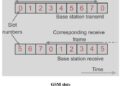
GPRS mobile devices are also categorized according to the number of time slots they can use for data transmission. GSM uses a TDMA system that provides eight time slots on a single radio frequency carrier.
GPRS can utilize these time slots to transmit packet data. The more time slots a mobile device can use simultaneously, the higher the possible data rate. To describe these capabilities, different GPRS multislot classes have been defined. These classes specify how many time slots a mobile device can use for:
- Downlink (receiving data)
- Uplink (sending data)
For example:
- Class 1 mobiles can send and receive data using only one slot in each direction.
- Class 29 mobiles can send and receive data using all eight available slots.
Example GPRS Multislot Classes
| Multislot Class | Receive Slots | Transmit Slots | Total Slots | Duplex Type |
|---|---|---|---|---|
| 1 | 1 | 1 | 2 | Semi-duplex |
| 2 | 2 | 1 | 3 | Semi-duplex |
| 5 | 2 | 2 | 4 | Semi-duplex |
| 8 | 4 | 1 | 5 | Semi-duplex |
| 10 | 4 | 2 | 5 | Semi-duplex |
| 12 | 4 | 4 | 5 | Semi-duplex |
| 19 | 6 | 2 | – | Semi-duplex |
| 23 | 6 | 6 | – | Semi-duplex |
| 29 | 8 | 8 | – | Semi-duplex |
Notes on Multislot Classes
- The minimum number of time slots may differ between uplink and downlink.
- The sum number represents the maximum combined total of uplink and downlink slots.
- Two types of duplex operation exist: semi-duplex and full duplex.
Many GPRS mobile phones support different performance levels depending on their multislot class. The class determines the maximum data rate that can be achieved under ideal network conditions.
The GPRS radio interface must support both GSM voice services and packet data communication. Therefore, modifications were made to GSM time slots and burst structures to accommodate packet data transmission. One important requirement of GPRS was compatibility with existing GSM networks. This allows both GSM-only devices and GPRS-enabled devices to operate within the same radio access network.