

Introduction
GPRS (General Packet Radio Service) enhances the GSM network by adding packet-switched data capabilities. Instead of creating an entirely new network, GPRS is implemented as an upgrade to the existing GSM infrastructure. This upgrade introduces new network elements while allowing them to coexist with existing GSM components such as MSC and GMSC.
GPRS Network Architecture Upgrades
To support packet data transmission, several new components are added to the GSM network. These elements enable efficient routing, data transfer, and connectivity with external networks. The major entities in GPRS network architecture include:
- MSC (Mobile Switching Center)
- GMSC (Gateway Mobile Switching Center)
- SGSN (Serving GPRS Support Node)
- GGSN (Gateway GPRS Support Node)
- PCU (Packet Control Unit)
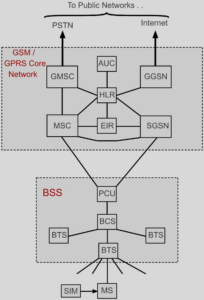
The addition of these components allows GSM networks to handle both circuit-switched (voice) and packet-switched (data) communication efficiently.
Serving GPRS Support Node (SGSN)
The SGSN is one of the most important components of the GPRS network. It acts as a gateway between mobile devices and the GPRS network. Main functions of SGSN include:
- Routing and transfer of data packets
- Mobility management
- Attach and detach procedures
- Logical link management
- User authentication
- Charging and billing data collection
The SGSN maintains a location register that stores information such as the current cell location and user details (e.g., IMSI and IP addresses).
Gateway GPRS Support Node (GGSN)
The GGSN connects the GPRS network to external packet-switched networks such as the Internet or private data networks. Main functions of GGSN include:
- Acting as a gateway between GPRS and external networks
- Routing incoming and outgoing data packets
- Checking whether a user is active before delivering data
- Providing security functions such as firewall and routing control
The GGSN hides the internal network structure from external systems and ensures secure data communication.
Packet Control Unit (PCU)
The PCU is responsible for managing packet data at the base station level. It determines whether the data should be routed through the circuit-switched GSM network or the packet-switched GPRS network. The PCU can be implemented as:
- A separate hardware unit, or
- Integrated within the Base Station Controller (BSC)
This flexibility helps reduce hardware costs and simplifies network upgrades.
GPRS Network Upgrading
Upgrading from GSM to GPRS involves additional investment, but it is significantly less expensive than building a completely new network. Key upgrade aspects include:
- Introduction of SGSN and GGSN nodes
- Addition of PCU in the base station subsystem
- Minor upgrades to BTS (often software-based)
Most upgrades can be implemented through software updates, minimizing capital expenditure (CAPEX). Operational costs (OPEX) also remain relatively low due to the reuse of existing infrastructure.
Evolution Towards 3G
The GPRS network architecture served as a foundation for future technologies such as EDGE and 3G UMTS. This evolutionary approach allowed network operators to gradually upgrade their systems without replacing the entire infrastructure.
GPRS Mobile Devices
GPRS-enabled mobile devices are designed to support both voice and packet data communication. These devices are categorized into different classes based on their capabilities. Unlike standard GSM phones, GPRS mobiles can:
- Send and receive data
- Access the Internet
- Support applications such as email and browsing
Some early GPRS devices, such as PDAs, even included keyboards for enhanced communication features.
Conclusion
GPRS network architecture extends the GSM system by introducing packet-switched data services. With components like SGSN, GGSN, and PCU, it enables efficient data communication while maintaining compatibility with existing infrastructure. This upgrade not only improved mobile data capabilities but also laid the groundwork for future technologies such as EDGE and 3G networks.