
GPRS Modulation Scheme
GPRS (General Packet Radio Service) extends the basic GSM radio interface. It uses the same signal format as GSM with a channel bandwidth of 200 kHz. GPRS also uses the same modulation technique known as Gaussian Minimum Shift Keying (GMSK).
Using the same modulation scheme allows GPRS to be added to existing GSM networks with minimal hardware upgrades. GMSK modulation was originally selected for GSM because it offers several advantages, including:
- High spectral efficiency
- Strong resistance to interference
- Low out-of-band interference
- Compatibility with non-linear RF power amplifiers
The ability to use a non-linear RF power amplifier is particularly important for mobile devices because it improves power efficiency and increases battery life.
GPRS Frame and Slot Structure
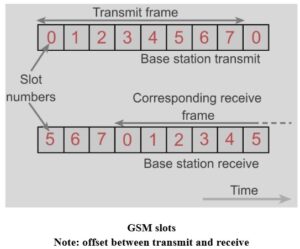
The GPRS air interface follows the same basic frame structure used in GSM. Each GSM carrier is divided into eight time slots using Time Division Multiple Access (TDMA). The slot structure used by GPRS is identical to GSM. It also uses the same power control and timing advance mechanisms to compensate for the different distances between the mobile device and the base station. This compatibility allows GPRS bursts to easily integrate into the existing GSM framework.
GPRS Burst Structure
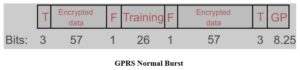
Each GPRS information burst has a duration of 0.577 MS, which is the same as in GSM. A normal GPRS burst contains:
- Two data blocks of 57 bits each
- Total of 114 bits per burst
To transmit one block of data lasting 20 MS, four bursts are required. These four bursts carry a total of 456 bits of encoded data. The Base Station Controller (BSC) dynamically assigns time slots to GPRS traffic depending on demand. Any unused slots can still be used for traditional GSM voice communication.
GPRS Normal Burst Components
- T – Tail bits
- F – Coding flag
Packet Data Channel (PDCH)
In GPRS, packet data is transmitted using the Packet Data Channel (PDCH). The BSC assigns PDCHs to specific time slots for packet data communication. There may be times when the PDCH is inactive. During these periods,
the mobile device can scan nearby base stations and measure their signal quality. This helps the network decide when a handover should occur. The base station can also estimate signal delay using a logical channel called the Packet Timing Advance Control Channel (PTCCH).
Compatibility with GSM
The GPRS radio interface is very similar to the GSM radio interface. Because of this similarity, both technologies can operate on the same radio access network. GSM voice bursts and GPRS data bursts can operate simultaneously on the same carrier and share the same frame structure. This design allowed network operators to gradually upgrade their GSM base stations to support GPRS without major infrastructure changes.
Error Correction in GPRS
GPRS uses different levels of error correction for data encoding. The level of error correction applied depends on signal quality and network conditions. Four coding schemes are used:
- CS-1
- CS-2
- CS-3
- CS-4
Lower coding schemes provide stronger error correction but lower data rates, while higher schemes provide faster data transmission with less error protection.