
Introduction to GSM
GSM (Global System for Mobile Communications) is a second-generation (2G) mobile communication system. It was first introduced in 1991 and is still widely used for voice calls and low data-rate services. Originally, GSM stood for Groupe Special Mobile, but as the technology expanded globally, it was renamed to Global System for Mobile Communications.
The popularity of GSM exceeded expectations. Initially developed as a European system, it quickly spread worldwide. By 2004, GSM had over one billion users, a milestone that landline systems took more than 100 years to achieve. Despite advancements in mobile technology, GSM remains in use due to its low cost, wide availability, and excellent battery efficiency.
History and Development of GSM
Earlier mobile systems such as AMPS (USA) and TACS (UK) were based on analog technology and faced scalability issues. To overcome these limitations, the European Conference of Postal and Telecommunications Administrations (CEPT) formed a group in 1983 to develop a digital standard.
In 1987, representatives from 13 European countries agreed to implement GSM. Later, the responsibility was transferred to the European Telecommunications Standards Institute (ETSI). The first GSM service was launched in Finland in 1991. Over time, GSM expanded globally and dominated the mobile market.
What is GSM? System Overview
GSM is a digital cellular technology designed to improve capacity and efficiency compared to first-generation analog systems. It uses TDMA (Time Division Multiple Access) to allow multiple users to share the same frequency. GSM digitizes and compresses data before transmission. It operates mainly in the 900 MHz and 1800 MHz frequency bands.
Key Features of GSM
- Digital communication for better voice quality and security
- Supports international roaming
- Efficient spectrum usage using TDMA
- SIM-based user identification
- Supports voice and basic data services
GSM Services
The primary function of GSM is voice communication using digital encoding techniques. In addition to voice, GSM supports several data services.
- Voice calls
- SMS (Short Message Service)
- Fax and data services
- Basic internet services (GPRS/EDGE)
SMS (Short Message Service)
SMS became one of the most popular GSM features. The first SMS was sent in 1992. It allowed low-cost, reliable, and fast communication, especially among younger users.
GSM Architecture
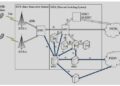
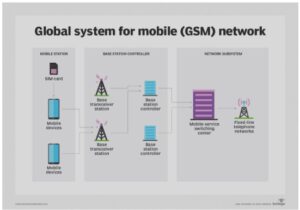
The GSM system consists of several key components:
- Mobile Station (MS): User’s mobile device
- Base Station Subsystem (BSS): Includes BTS and BSC for communication
- Network Switching Subsystem (NSS): Handles call routing
- HLR & VLR: Databases for subscriber information
- Authentication Center (AuC): Ensures security
- Equipment Identity Register (EIR): Tracks device identity
SIM (Subscriber Identity Module) is a key feature that allows users to switch devices easily while maintaining their identity and data.
Technical Specifications of GSM
| Parameter | Specification |
|---|---|
| Multiple Access | FDMA / TDMA |
| Duplex Technique | FDD |
| Frequency Band | 900 MHz / 1800 MHz |
| Channel Spacing | 200 kHz |
| Modulation | GMSK |
| Data Rate | 270.833 kbps |
| Time Slots | 8 per channel |
Working of GSM Technology
GSM uses a combination of FDMA and TDMA techniques. Each frequency channel is divided into time slots, allowing multiple users to share the same channel efficiently. Speech signals are digitized, compressed, and encrypted before transmission, ensuring privacy and efficient use of bandwidth.
Further Developments in GSM
GPRS (General Packet Radio Service)
GPRS introduced packet-based data transmission, allowing basic internet access and improved data speeds compared to traditional GSM.
EDGE (Enhanced Data Rates for GSM Evolution)
EDGE improved data rates up to 384 kbps using advanced modulation techniques, although it is still slower compared to modern networks.
Advantages of GSM
- Wide global coverage
- High-quality voice communication
- Secure communication using encryption
- Easy device switching with SIM cards
- Long battery life
- Low cost of devices and services
Disadvantages of GSM
- Low data speed compared to 3G, 4G, and 5G
- Limited multimedia capabilities
- Network congestion in high-density areas
- Requires repeaters for better coverage
Conclusion
GSM (2G) technology played a vital role in the evolution of mobile communication. It introduced digital communication, international roaming, and SIM-based identity, which revolutionized the telecom industry. Although modern technologies like 4G and 5G have largely replaced GSM, it continues to serve as a reliable and cost-effective solution for basic communication and legacy systems.