

Introduction
Ham radio, or amateur radio, uses a wide range of frequencies for communication. Even non-licensed users can listen to these transmissions using radio receivers or scanners. Many frequency bands across the radio spectrum are allocated specifically for amateur radio use.
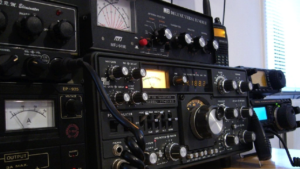
Amateur radio operators can work on frequencies ranging from just above the AM broadcast band to the gigahertz range. Many ham bands are located between the AM radio band (around 1.6 MHz) and just above the citizens band (27 MHz).
- 15 to 27 MHz is suitable for long-distance communication during the day.
- 1.6 to 15 MHz is ideal for long-distance communication at night.
These bands are historically known as short-wave bands. Unlike FM radio and TV frequencies, which are mostly limited to line-of-sight transmission, short-wave signals can bounce off the ionosphere, allowing communication over very long distances.
Some amateur operators use Morse code, while others use voice communication. Morse code often succeeds when voice transmissions fail because it requires less bandwidth. Many digital modes are also used, enabling communication through radio modems and networks.
Propagation and Ham Radio Bands
Radio signals travel through different types of propagation. The main types include:
Ground Wave Propagation
This type of propagation is common in the low-frequency (LF) portion of the spectrum. Signals follow the Earth’s surface, allowing them to be detected beyond the horizon. It is commonly used by long-wave and medium-wave broadcast stations.
Ionospheric Propagation
Ionospheric propagation mainly affects short-wave bands. Signals reflect from the ionosphere, allowing communication over long distances. This also affects the lower part of the VHF spectrum.
Tropospheric Propagation
This type of propagation affects frequencies above 30 MHz Under certain atmospheric conditions, signals can travel much farther than normal, creating long-distance communication opportunities.
Ham Radio Bands
Amateur radio bands are available across almost the entire radio spectrum.
136 kHz LF Ham Band
The 136 kHz band is the lowest frequency amateur band. Although not allocated in all countries, it is popular among experimenters interested in LF operation.
Because of the very narrow bandwidth, Morse code is commonly used. Many operators use extremely slow Morse code, narrow filters, and digital signal processing techniques. Data transmissions are also used, but at low data rates.
HF Ham Bands
There are nine HF amateur bands allocated worldwide, with slight variations depending on the country.
| Amateur Band (metres) | UK Allocation (MHz) | USA Allocation (MHz) |
|---|---|---|
| 160 | 1.810 – 2.000 | 1.800 – 2.000 |
| 80 | 3.500 – 3.800 | 3.500 – 4.000 |
| 40 | 7.000 – 7.200 | 7.000 – 7.300 |
| 30 | 10.100 – 10.150 | 10.100 – 10.150 |
| 20 | 14.100 – 14.350 | 14.100 – 14.350 |
| 17 | 18.068 – 18.168 | 18.068 – 18.168 |
| 15 | 21.000 – 21.450 | 21.000 – 21.450 |
| 12 | 24.890 – 24.990 | 24.890 – 24.990 |
| 10 | 28.000 – 29.700 | 28.000 – 29.700 |
VHF Ham Radio Bands
The VHF bands are user-friendly, with compact equipment and small antennas. Many operators install VHF radios in vehicles or small home stations.
| Band | UK Allocation (MHz) | USA Allocation (MHz) |
|---|---|---|
| 6 meters | 50.00 – 52.00 | 50.00 – 54.00 |
| 4 meters | 70.00 – 70.50 | No allocation |
| 2 meters | 144.00 – 146.00 | 144.00 – 148.00 |
| 1.25 meters | No allocation | 219.00 – 220.00 / 222.00 – 225.00 |
Each VHF band has its own characteristics depending on propagation conditions, equipment availability, and allocation size.
UHF Ham Radio Bands
UHF amateur bands provide a different operating environment compared to HF bands. Equipment is compact, antennas are small, and installations are usually simple.
| Band | UK Allocation (MHz) | USA Allocation (MHz) |
|---|---|---|
| 70 cm | 430.00 – 440.00 | 420.00 – 450.00 |
| 33 cm | No allocation | 902.00 – 928.00 |
| 23 cm | 1240 – 1325 | 1240 – 1300 |
| 13 cm | 2310 – 2450 | 2300 – 2310 / 2390 – 2450 |
Each VHF and UHF band has unique characteristics based on propagation, equipment, and allocation differences. The 70-centimetre band is one of the most popular UHF amateur bands worldwide.
Conclusion
Ham radio bands cover a wide range of frequencies across the radio spectrum. Each band offers unique propagation characteristics and communication possibilities. From long-distance HF communication to short-range VHF and UHF operations, amateur radio provides a versatile platform for experimentation, communication, and technical learning.