

Circuit Breaker – Need and Definition
Electricity is supplied to homes and other locations through a large circuit consisting of two main conductors. One conductor is connected to the power plant, known as the hot wire, and the other is connected to the ground, known as the ground wire. A potential difference exists between these two wires, allowing electric current to flow.
When appliances with sufficient resistance are connected, the circuit operates smoothly. However, situations such as short circuits, excessive current flow, or accidental contact between the hot wire and the ground wire can lead to overheating or fire hazards. To prevent such dangerous conditions, circuit protection devices are used to automatically interrupt the power supply.
Methods of Circuit Protection
Fuse
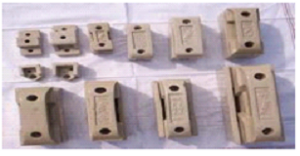
A fuse consists of a thin wire enclosed within a casing. When excessive current flows through the circuit, the fuse wire melts and breaks the circuit. Although fuses are simple and effective, they are unreliable because once blown, they must be replaced manually. Therefore, they are often not preferred in modern electrical systems.
Switch-Based Protection
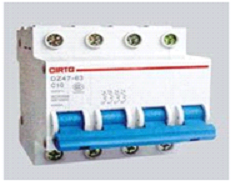
Another method of circuit protection involves the use of an automatic switch that trips when it detects an overcurrent or fault condition. This switch isolates the faulty section from the circuit and can be reset after the fault is cleared. Compared to fuses, this method offers faster fault diagnosis, easier restoration, and improved electrical safety.
Electronic Fuse
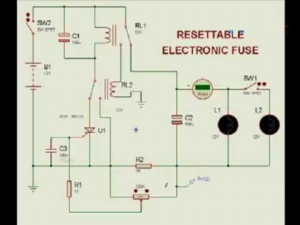
An electronic fuse uses electronic components to sense overcurrent conditions. A capacitor of 100 µF is used, and the current flowing through the circuit can be adjusted using a 100 kΩ potentiometer. The relay voltage rating must match the applied voltage. When switch SW1 is turned ON, load L2 enters the circuit, increasing the current flow through resistor R2 and hence increasing the voltage drop across it.
Resettable Electronic Fuse – Working
The increased voltage across R2 is applied through the 100 kΩ preset and resistor R1, which triggers the SCR (U1). This SCR activates the relay (RL1), disconnecting the supply to the load and simultaneously removing power from the SCR. To reset the system, the overload must be removed, and switch SW2 should be turned OFF and then ON again. Any SCR meeting the voltage and gate-triggering requirements can be used.
Need for Electronic Circuit Breaker
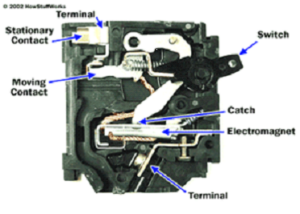
In a traditional Miniature Circuit Breaker (MCB), a bimetallic strip protects against overload conditions, while an electromagnet provides short-circuit protection. During overload, the bimetallic strip bends due to heat, releasing a spring and opening the contacts. During a short circuit, a high current through the electromagnetic coil generates a magnetic force that opens the contacts.
Limitations of Conventional MCB
- High cost, which increases with short-circuit current rating
- Ambient temperature affects bimetallic strip performance
- Mechanical wear and tear reduces lifespan
- Longer trip response time
To overcome these drawbacks, electronic circuit breakers are used. They do not rely on electromagnetic coils, thermal strips, or mechanical components.
Electronic Circuit Breaker – Definition
An electronic circuit breaker uses feedback from the load to control an automatically operating switch. When excessive current is detected, the switch opens and disconnects the load. After a specific time or reset action, the switch can close again.
Current is sensed using a series resistor or current sensor. The resulting voltage drop is rectified and compared with a preset reference using a comparator. When the current exceeds the preset limit, the comparator output activates a relay through a MOSFET, instantly disconnecting the load.
Working Principle of an Electronic Circuit Breaker
The current flowing through the load is continuously monitored. During normal operation, the voltage drop across the sensing resistor remains below the reference voltage, keeping the relay energized and the load connected.
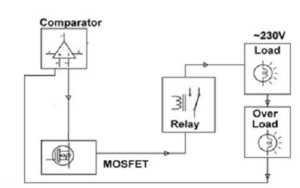
When an overcurrent occurs, the voltage drop exceeds the reference value, causing the comparator to switch states. This turns OFF the MOSFET, de-energizes the relay, and disconnects the load from the supply. This method provides faster protection compared to thermal-based MCBs.
Advantages of Electronic Circuit Breaker
- Fast response time
- Unaffected by inrush currents
- No mechanical wear and tear
- Compact and lightweight
- Lower maintenance cost
Practical Electronic Circuit Breakers
Electronic Protection Switch by Phoenix
This device operates on a 24 V DC supply and includes monitoring and remote signaling features. It supports remote-controlled reset functionality and is widely used to protect relays, programmable controllers, motors, sensors, actuators, and valves.
HFDE308032
This electronic circuit breaker supports adjustable current ratings from 15 A to 80 A. It offers adjustable long-time, short-time, and instantaneous settings, along with integrated status signaling and alarm features.