

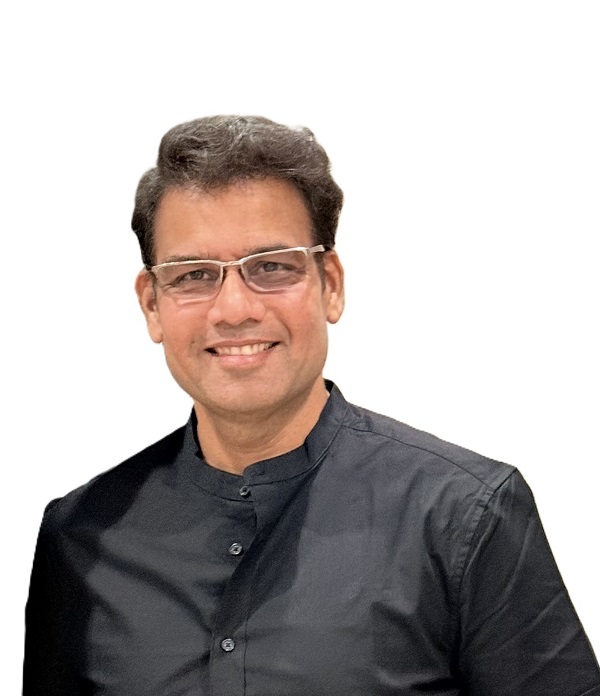
In an exclusive interaction Vaishali Umredkar, Editor of Semiconductor For You spoke with Mr. Rajneesh Rathi, Associate Vice President – Products at Marvell Technology on India’s growing ownership in semiconductor product development, AI infrastructure innovation, talent transformation and the strategic role of R&D across global product lines. The discussion highlights how India is moving up the semiconductor value chain through deeper engineering leadership and advanced product responsibility.
You lead multiple product lines at Marvell. Could you briefly explain your current role and responsibilities?
Rajneesh: I lead global engineering for three product lines at Marvell — Octeon Fusion® Wireless System-on-Chip solutions for Tier 1 Wireless Network OEM, Liquid Security® Cloud Hardware Security Module used by hyperscalers for secure key management and Fibre Channel storage products. In addition, I am also sponsor leader of generative AI initiatives within my Business Unit to re-define software workflows using agentic AI, methodologies and explore how advanced AI techniques can improve engineering productivity and future readiness.
How has your leadership journey contributed to Marvell India’s evolution?
Rajneesh: Over the last six years, Marvell India has expanded its workforce significantly. More importantly, Marvell India’s role has evolved from supporting global teams to owning complete product lines. Today, teams here define product roadmaps, solutioning, architecture, design, testing and customer support. This shift reflects the company’s long-term vision of driving more product ownership directly from India.
What role does R&D in India play in strengthening the semiconductor ecosystem?
Rajneesh: Marvell operates in Bangalore, Hyderabad and Pune, and our work sits at the top of the semiconductor value chain—product definition, SoC architecture and advanced chip design. While India’s fab ecosystem is growing, companies like Marvell complement that ecosystem by proving India’s capability in advanced nodes such as 2nm and 3nm design innovation.
How does India’s engineering talent support Marvell’s growth strategy?
Rajneesh: India offers one of the world’s strongest semiconductor talent pools, with more than 25% of global semiconductor capability located here. For Marvell, this is not just about scale or cost—it is about accessing highly skilled engineers who can take ownership of complex product development and deliver first-silicon (A0 to production) success. We take pride in what we do at Marvell India, and our engineering talent plays critical role in Marvell’s success.
Which innovation areas do you see defining Marvell’s next four to five years?
Rajneesh: AI data center infrastructure will remain a major growth engine. Marvell is deeply involved in custom silicon solutions, advanced packaging, die-to-die interfaces, optical interconnects and scale-up, scale-out and scale-across networking architectures. These technologies are critical for hyperscale AI data centers where performance per watt, density and connectivity must continuously improve.
How is Marvell positioned in India’s AI and data infrastructure growth story?
Rajneesh: Marvell has strong capabilities across AI compute, optical connectivity, data interconnect and photonic technologies. Whether it is custom CPUs, DPUs, XPUs, optical networking, or memory connectivity, Marvell plays an important role across the AI data center stack, and much of that engineering is increasingly anchored in India.
Is Marvell collaborating with academic institutions to strengthen future talent?
Rajneesh: Yes, one important example is our collaboration with Indian Institute of Technology Hyderabad, where we established a research lab that gives students access to our latest DPU platform and open-source data acceleration software. Students work on real-world industry problems with mentorship from Marvell engineers, helping them innovate and become industry-ready much earlier.
What advice would you give young engineers entering semiconductors and advanced technology fields?
Rajneesh: Engineers must first identify a domain they want to master—chip design, networking, software or security—and build strong programming and tool expertise around it. At the same time, they must learn how to work effectively with generative AI, because future engineering will depend on managing AI-driven workflows rather than only manual execution.
Many engineers fear AI may reduce job opportunities. What is your perspective?
Rajneesh: AI is changing job definitions, not eliminating engineering relevance. Just as computers changed accounting without removing accountants, AI will transform engineering workflows. Engineers who learn to validate, guide and integrate AI-generated outputs into larger architectures will remain highly valuable.