

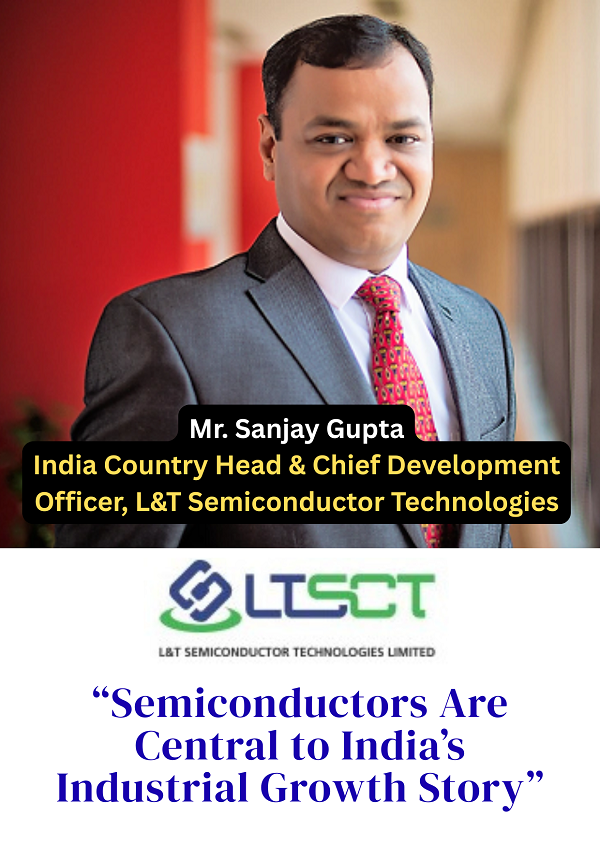
In a candid conversation with Vaishali, Editor of Semiconductor For You, Mr. Sanjay Gupta, India Country Head & Chief Development Officer at L&T Semiconductor Technologies, shares his journey from semiconductor design engineer to industry leader, while outlining how L&T is building India’s semiconductor future through product innovation in automotive, energy, industrial, and AI-driven infrastructure.
Your journey from a technical engineer to leading semiconductor businesses has been remarkable. How has this experience shaped your leadership at L&T Semiconductor?
My semiconductor journey began as a fresher in one of the early chip design companies operating in India, where I gained exposure to both analog and digital semiconductor design. Early assignments with global companies gave me opportunities to work on advanced processor and wireless chip programs, followed by leadership roles in building large semiconductor design centers in India. Over the years, I led teams across wireless, networking, automotive, and secure applications, scaling engineering organizations from a few hundred to several thousand professionals. At L&T Semiconductor, this experience helps me focus on building a strong product-led semiconductor organization rooted in Indian talent, global quality standards, and long-term strategic execution.
L&T Semiconductor has gained strong industry attention recently. What is your larger vision for the company in India’s semiconductor ecosystem?
L&T Semiconductor aims to become one of India’s first serious fabless semiconductor product companies with strong indigenous intellectual property. India’s electronics demand is expanding rapidly, and semiconductor consumption is expected to rise significantly over the coming decade. Our vision is to participate in this growth by designing differentiated semiconductor products that address strategic sectors while strengthening India’s position in the global semiconductor value chain. The focus is not only on serving domestic demand but also on creating products that can compete internationally.
Which application segments are currently driving your product development strategy?
We have prioritized automotive, industrial, energy, and security because these are long-cycle markets where reliability, performance, and quality matter more than price alone. These sectors also offer strong long-term opportunities because once a product is qualified, it remains deeply integrated into customer platforms for years. In automotive, the growth of electric vehicles is creating significant semiconductor demand across traction systems, onboard chargers, charging infrastructure, and power conversion systems.
Energy appears to be a major opportunity area. How is L&T Semiconductor approaching this segment?
Energy is one of the fastest-growing sectors in India, spanning generation, long-distance transmission, and urban distribution. Every stage increasingly depends on advanced power semiconductors. As India scales renewable energy and modernizes grid infrastructure, semiconductor innovation becomes critical for efficiency and control. We are working closely on solutions that support power conversion, grid applications, and high-voltage systems where long-term technology development is essential.
Wide bandgap technologies such as silicon carbide are receiving major attention globally. How do you see their role in future semiconductor products?
Wide bandgap materials such as silicon carbide offer major advantages in power efficiency, thermal performance, and switching speed. These devices can operate at significantly higher efficiency while reducing thermal losses, making them highly valuable in energy systems, EV platforms, and high-performance computing environments. Their role will continue to expand because there is no practical substitute in many high-power applications.
Data center infrastructure is evolving rapidly with AI. Where do you see semiconductor innovation contributing most?
AI has fundamentally changed data center architecture. If we simplify it, AI infrastructure depends on multiple interconnected layers, beginning with energy delivery, followed by compute, connectivity, infrastructure, and application deployment. Semiconductors are central to every layer — from power systems and processors to interconnects and infrastructure control. Data centers are becoming far more strategic because AI workloads require much higher efficiency, scalability, and power density than traditional computing environments.
What are the biggest challenges for semiconductor product design in India today?
One of the biggest challenges is access to advanced design tools, IP, and ecosystem support. Semiconductor product development requires expensive EDA tools, licensed IP blocks, and manufacturing readiness from day one. For emerging Indian companies, this creates a high entry barrier. Along with design capability, cost competitiveness is equally critical because global competition is intense. Strong policy support, easier access to infrastructure, and long-term ecosystem development are necessary to help Indian semiconductor product companies scale successfully.