Semiconductor for You
  • Home
  • Semiconductor News
  • Semiconductor Magazine
  • Technology
    • Automotive
    • Consumer Electronics
    • IoT
    • Lighting
    • Power Management
    • Wireless
    • Personal Electronics
    • Hardware & Software
    • Research
    • Medical Electronics
    • Embedded Design
    • Aerospace & Defence
    • Artificial Intelligence
  • Interview
  • Industries
  • Market
  • Knowledge Base
  • Events
  • Tools
    • Resistor Color Code Calculator
No Result
View All Result
  • Home
  • Semiconductor News
  • Semiconductor Magazine
  • Technology
    • Automotive
    • Consumer Electronics
    • IoT
    • Lighting
    • Power Management
    • Wireless
    • Personal Electronics
    • Hardware & Software
    • Research
    • Medical Electronics
    • Embedded Design
    • Aerospace & Defence
    • Artificial Intelligence
  • Interview
  • Industries
  • Market
  • Knowledge Base
  • Events
  • Tools
    • Resistor Color Code Calculator
No Result
View All Result
Semiconductor for You
No Result
View All Result
Home Knowledge Base

Lenticular Lenses: Working, Advantages, Disadvantages, and Applications

Komal Ganvir by Komal Ganvir
April 3, 2026
in Knowledge Base
0

Introduction

With the rise of 3D movies such as Avatar, Up, and Alice in Wonderland, the demand for 3D viewing technology has increased significantly. As a result, television manufacturers have developed various methods to display 3D content at home. Traditionally, 3D viewing required special glasses, which are categorized into passive and active systems. However, newer technologies now allow users to experience 3D visuals without the need for glasses. One such innovation is lenticular lens technology.

What is Lenticular Viewing?

Lenticular viewing is a technique that uses an array of tiny cylindrical lenses, known as lenticules, to create a 3D effect. These lenses are mounted on a transparent sheet, which is placed over an LCD screen. When a viewer looks at the screen, each eye sees a slightly different image.
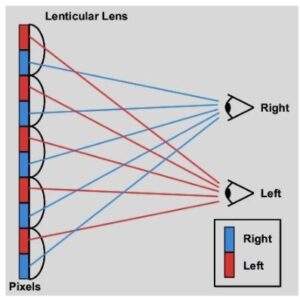
The brain combines these two images to form a single 3D image. This phenomenon is known as stereopsis, which allows humans to perceive depth.

Working Principle of Lenticular Lenses

The lenticular lens directs different images to each eye based on the viewing angle. This creates the illusion of depth without requiring 3D glasses. You can observe a simple version of this effect by rolling a magazine into a cylindrical shape and looking through it with one eye at a time. Each eye sees a different perspective, and when combined, the brain forms a complete image with depth.

Advantages of Lenticular Lenses

  • No need for 3D glasses
  • Provides a realistic 3D viewing experience
  • Useful for people with certain visual impairments
  • Widely used in lenticular printing for images and advertisements

Disadvantages of Lenticular Lenses

  • Requires specially designed images for proper 3D effect
  • Viewing standard content may result in blurred or double images
  • Limited viewing angles (sweet spot required)
  • Can cause eye strain or motion sickness over long periods
  • Higher manufacturing cost
  • Not as widely adopted as other 3D technologies

Applications of Lenticular Technology

  • 3D displays and televisions
  • Advertising signage
  • Product packaging
  • Magazine inserts and printed materials
  • Specialized eyeglasses such as bifocals

Conclusion

Lenticular lens technology offers an innovative way to experience 3D visuals without the need for glasses. Although it has some limitations, such as viewing angle restrictions and higher costs, it remains a valuable solution for applications in advertising, displays, and printing. With further advancements, lenticular technology may become more widely accessible in the future.


Content Protection by DMCA.com
Tags: Lenticular Lenses
Komal Ganvir

Komal Ganvir

Browse by Category

  • Aerospace and Defence
  • Articles
  • Automotive
  • Consumer-Electronics
  • Hardware & Software
  • Interview
  • IoT
  • Knowledge Base
  • Lighting
  • Market
  • personal-electronics
  • Power Management
  • Research
  • Semiconductor Events
  • Semiconductor News
  • Technology
  • Wireless
Semiconductor for You

Semiconductor For You is a resource hub for electronics engineers and industrialist. With its blend of
technology features, news and new product information, Semiconductor For You keeps designers and
managers up to date with the fastest moving industry in the world.

Follow Us

Browse by Category

  • Aerospace and Defence
  • Articles
  • Automotive
  • Consumer-Electronics
  • Hardware & Software
  • Interview
  • IoT
  • Knowledge Base
  • Lighting
  • Market
  • personal-electronics
  • Power Management
  • Research
  • Semiconductor Events
  • Semiconductor News
  • Technology
  • Wireless

Recent News

3D TV Technology: Working, Types, Advantages, and Future Developments

3D TV Technology: Working, Types, Advantages, and Future Developments

April 3, 2026
Renesas’ RadiationHardened ICs Take Flight on NASA’s Artemis II    Crewed Lunar Mission

Renesas’ RadiationHardened ICs Take Flight on NASA’s Artemis II Crewed Lunar Mission

April 3, 2026
  • About
  • Advertise
  • Privacy & Policy
  • Contact

© 2022 Semiconductor For You

No Result
View All Result
  • Home
  • Semiconductor News
  • Technology
    • IoT
    • Wireless
    • Power Management
    • Automotive
    • Hardware & Software
  • Market
  • Interview
  • Knowledge Base
  • Tools
    • Resistor Color Code Calculator

© 2022 Semiconductor For You