

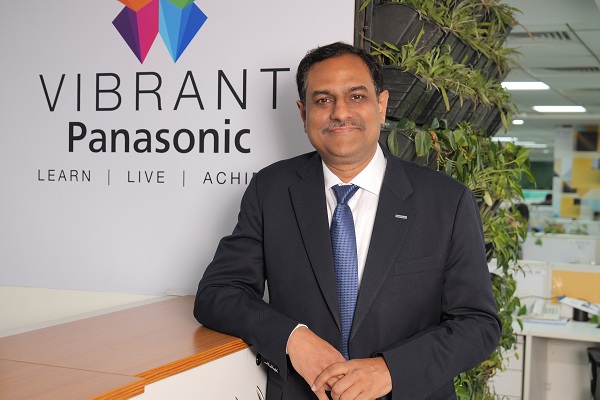
As Indian manufacturers accelerate automation to meet global quality and productivity benchmarks, motion control is becoming a decisive differentiator. In this interview, Narayan Kumar, Chief Business Officer, Panasonic Industry and Energy India (PIDEIN), discusses how Panasonic’s MINAS E7 servo system addresses commissioning challenges, precision demands, space constraints, and competitiveness for Indian OEMs in fast-evolving industrial environments.
How does MINAS E7 simplify deployment with its tuneless one-minute auto-debugging?
MINAS E7 has been engineered to take the trial-and-error out of commissioning, which is often the most stressful phase for Indian OEMs and system integrators. Its tuneless one-minute auto‑debugging allows the servo driver to quickly understand the machine’s load characteristics and automatically adapt key control parameters, so a line can move from installation to stable operation in a matter of minutes rather than long shifts of manual tweaking. In a market where manufacturing plants are coping with skill gaps and tight shutdown windows, this capability directly reduces dependence on a handful of experts, cuts start-up risk, and makes advanced motion control far more approachable for mid-sized manufacturers
Which industries will benefit most from E7’s high-speed response and precision?
Industries that rely on high-speed, high-precision motion control will benefit most from the MINAS E7 servo system. This includes packaging, machine tool and material handling, where fast response and accurate positioning are critical for throughput and repeatability; printing and converting, which demand precise speed control and registration; and testing and inspection equipment, where micron-level accuracy and stable motion are essential.
Additionally, semiconductor and electronics manufacturing will gain from E7’s 3.0 kHz high-speed response, 20-bit encoder resolution, and stable control at high rotation speeds, enabling precise, vibration-suppressed motion in compact, space-constrained setups.
For Indian firms striving to meet export-grade quality while running cost‑efficient operations, such precise motion control becomes a quiet but powerful competitive advantage.
Why is the compact 27% smaller design important for modern manufacturing setups?
The compact design of the MINAS E7—up to 27% smaller than previous models in the same class—addresses a key challenge in modern manufacturing: space efficiency and design flexibility. As production lines become more automated, flexible, and modular, control panels and machines are increasingly space-constrained. A smaller servo driver allows OEMs to design more compact machines, increase component density within panels, and reduce overall cabinet size.
The space-saving also improves thermal management, wiring efficiency, and layout flexibility, making installation and maintenance easier. For manufacturers, it translates into lower material and enclosure costs, faster integration, and the ability to build smarter, high-performance equipment without compromising on speed, precision, or reliability.
How does Panaterm 7 improve multi-axis monitoring and maintenance efficiency?
Panaterm 7 enables simultaneous monitoring, comparison, and control of up to 32 axes from a single interface. This allows engineers to view parameters, operating status, and performance data across multiple servo axes in real time, rather than diagnosing each axis individually. The software capability enhances logging and high-speed sampling, supporting precise measurement and long-duration data capture, making it easier to identify abnormalities, analyze trends, and perform predictive maintenance. By simplifying multi-axis debugging and reducing troubleshooting time, Panaterm 7 helps OEMs and shop floor teams improve uptime, accelerate commissioning, and maintain stable operation in complex automation environments.
How will MINAS E7 help Indian OEMs build globally competitive automation equipment?
MINAS E7 enables OEMs achieve higher efficiency, consistent quality, and faster time-to-market, while optimizing total cost of ownership. Its high-speed, high-precision servo control ensures accurate positioning and stable motion, reducing material waste, rework, and quality variations, key requirements for meeting international manufacturing standards.
The intelligent control and energy-efficient operation precisely match power to load conditions, lowering energy consumption and supporting sustainable manufacturing goals. At the same time, features such as tuneless one-minute auto-debugging and a compact, miniature design significantly reduce commissioning time, downtime, and panel space, enabling OEMs to design more cost-effective and flexible machines.