

Introduction
The primary function of power electronics is to process, control, and regulate the flow of electrical energy by supplying voltages and currents in a form best suited for the connected load. Modern power electronic converters are widely used in applications such as switched-mode power supplies, active power filters, electric motor drives, renewable energy systems, flexible AC transmission systems (FACTS), and automotive electronics.
In conventional electronics, voltages and currents are used mainly to transmit information, whereas in power electronics, they are used to transfer power. Power electronic converters are employed wherever there is a requirement to change the form of electrical energy.
Examples include DC–DC converters used in mobile devices such as smartphones and tablets, and AC–DC converters found in computers, televisions, and power adapters. Large-scale power electronic systems also regulate the flow of hundreds of megawatts of electrical power in modern power grids.
Dual Converter
A dual converter is a power electronic system that combines a rectifier and an inverter. It converts alternating current (AC) into direct current (DC) and then converts the DC back into AC, with the load connected between the two stages.
Dual converters may be constructed using either single-phase or three-phase supplies. They consist of two thyristor bridges:
- One bridge operates as a rectifier to convert AC to DC.
- The other bridge operates as an inverter to convert DC back to AC.
Single Phase Dual Converter
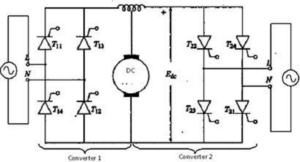
A single-phase dual converter uses a single-phase AC supply as its input. The supply is fed to converter 1, which performs rectification and supplies DC power to the load.
Principle of Operation
In this process, the AC input is supplied to converter 1 for rectification.
- During the positive half cycle of the input, the forward-biased thyristors conduct and produce rectified DC.
- During the negative half cycle, the reverse-biased thyristors conduct, again producing rectified DC.
An inductor is used to block converter 2 during this operation. Thyristors begin conducting only when a gate pulse is applied, and they continue to conduct until the current through them falls below the holding current.
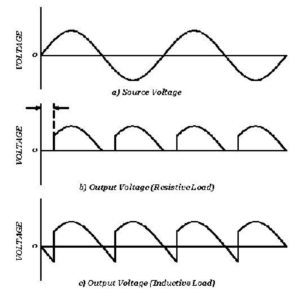
When DC-to-AC conversion is required, converter 2 is activated while converter 1 is blocked. In this mode, the DC supply behaves as the input source for inverter operation.
Firing of Thyristors
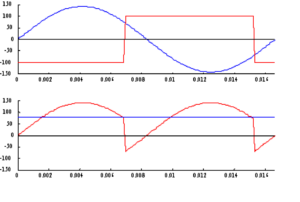
For a thyristor to conduct, a gate trigger pulse and the appropriate line voltage must be applied simultaneously.
Each thyristor bridge in a dual converter requires a dedicated gate drive circuit. The gate pulses must be synchronized with the supply voltage. Any delay may cause zero-crossing jitter and frequency instability. To prevent such issues, phase-locked loops (PLLs) and comparators are commonly used in gate drive circuits.
Speed and Polarity Control of DC Motor Using Single Phase Dual Converter
In this application, a set of four SCRs is connected on either side of the DC motor, with the motor acting as the load. A single-phase dual converter allows both speed control and direction control of the DC motor. The thyristors are triggered using a microcontroller through optocouplers to ensure electrical isolation.
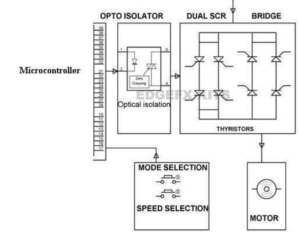
One set of thyristors controls the motor rotation in one direction, while another set controls rotation in the opposite direction. The motor speed is controlled by varying the firing angle of the SCRs. Mode selection and speed selection are achieved using microcontroller-interfaced switches, allowing the user to select motor direction and speed.
Applications of Single Phase Dual Converter
- Speed and direction control of DC motors
- DC motor drives in industrial applications
- Improved power rating and voltage capability
- Higher DC output voltage compared to four-leg converters
- Reduced losses and fewer switching devices
- Improved efficiency and power factor
Conclusion
Power electronic converters play a vital role in modern electrical and electronic systems. Dual converters, especially single-phase dual converters, offer efficient control of voltage, speed, and direction in DC motor applications. Their ability to provide high efficiency, improved power factor, and flexible control makes them essential in industrial and power system applications.