
Introduction
QRP, or low power operation, has a large and growing fan base among amateur radio operators. The term originates from the Q-code used in Morse communications, where “QRP” means “Shall I reduce power?”
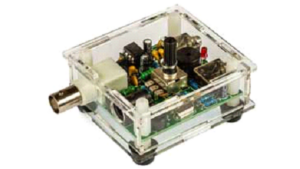
A small cheap ham radio QRP transceiver kit built
Even many radio amateurs with full legal power licenses prefer QRP operation because it provides a great sense of achievement and introduces new challenges in communication and equipment building. Some operators exclusively run QRP stations, while others alternate between high power and low power to add variety to their amateur radio activities.
What is QRP?
In amateur radio, QRP refers to low power operation. Although specific limits are defined, QRP often represents more than just reduced output power — it reflects a philosophy of simplicity, home construction, and operating skill. Many QRP operators build their own transmitters, receivers, and wire antennas. This homebrew approach is a key part of the QRP tradition.
Because signal strength is lower than high-power stations, most QRP activity traditionally uses Morse code (CW). Morse allows contacts to be made under weak signal conditions. However, Single Sideband (SSB) and digital modes are also widely used for QRP.
Understanding Power Reduction
Reducing power does not always reduce signal readability as much as expected. For example, reducing transmitter power from 400 watts to 4 watts represents a 20 dB reduction.
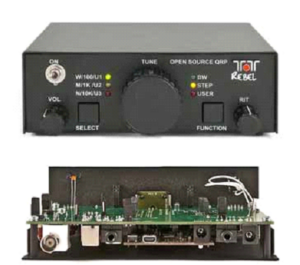
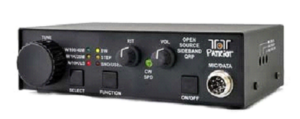
Typical commercially made QRP transceiver
Since approximately 6 dB corresponds to one S-unit on a signal meter, this reduction equals just over three S-points. A station received at S9 at 400W might still be received around S6 at 4W. Although QRP stations may struggle in large pile-ups, many successful contacts are made daily across the amateur bands, proving that low-power operation is highly effective.
QRP Power Limits
The commonly accepted QRP power limits are:
- 5 watts or less output for CW (Morse code)
- 10 watts PEP or less for SSB
These limits are widely recognized by amateur radio organizations and contest rules worldwide. The term QRPp is also used for extremely low-power operation, generally less than 1 watt.
QRP Frequencies
To help low-power operators make contacts without competing against high-power stations, certain frequencies within the HF amateur bands are recognized as QRP activity centers. These are not exclusive frequencies but recommended gathering spots for QRP operators.
| Band (Meters) | CW QRP Frequency (MHz) | SSB QRP Frequency (MHz) |
|---|---|---|
| 160m | 1.843 (EU), 1.810 (USA) | 1.910 |
| 80m | 3.560 | 3.690 (EU), 3.985 (USA) |
| 40m | 7.030, 7.122 (USA) | 7.090 (EU), 7.285 (USA) |
| 30m | 10.106, 10.116 | — |
| 20m | 14.060 | 14.285 |
| 17m | 18.096 | 18.130 |
| 15m | 21.060 | 21.285 (EU), 21.385 (USA) |
| 12m | 24.906 | 24.950 |
| 10m | 28.060 | 28.365 (EU), 28.385 (USA) |
These frequencies are better described as “centers of activity” rather than strict calling frequencies. Once contact is established, operators typically move slightly away from the center frequency to continue their conversation.
Why QRP is Popular
Despite modern transceivers offering high output power and advanced features, QRP continues to grow in popularity. Many operators enjoy the technical challenge, the satisfaction of building their own equipment, and the skill required to make reliable contacts with minimal power.
QRP operation reflects the original spirit of amateur radio — experimentation, learning, and communication through innovation. Because of this, QRP will remain an important and respected aspect of amateur radio for years to come.