
In both electrical and electronic circuits, resistors are widely used to control the flow of current or to produce a voltage drop. To perform this function, every resistor must have a specific resistance value.
Resistors are available in a wide range of resistance values, from fractions of an ohm (Ω) to several million ohms (MΩ). Manufacturing resistors in every possible value would be impractical. Therefore, resistors are produced in what are known as preferred values.
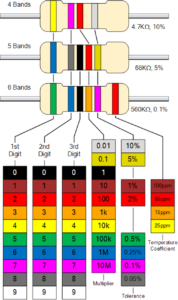
For large power resistors, resistance value, tolerance, and wattage rating are printed directly on the body. However, small resistors such as 1/4-watt carbon or film resistors are too small to print numbers clearly. To solve this problem, coloured bands are painted on the resistor body to represent its value and tolerance. This identification system is known as the Resistor Color Code, an internationally recognized standard.
What Is the Resistor Color Code?
The resistor color code consists of a series of coloured bands, where each color represents a numerical digit or multiplier. The bands are always read from left to right, starting from the band closest to the resistor lead.
The tolerance band is usually wider and placed at the right end of the resistor.
Standard Resistor Color Code Table
| Color | Digit | Multiplier | Tolerance |
|---|---|---|---|
| Black | 0 | 1 | – |
| Brown | 1 | 10 | ±1% |
| Red | 2 | 100 | ±2% |
| Orange | 3 | 1,000 | – |
| Yellow | 4 | 10,000 | – |
| Green | 5 | 100,000 | ±0.5% |
| Blue | 6 | 1,000,000 | ±0.25% |
| Violet | 7 | 10,000,000 | ±0.1% |
| Grey | 8 | – | ±0.05% |
| White | 9 | – | – |
| Gold | – | 0.1 | ±5% |
| Silver | – | 0.01 | ±10% |
| None | – | – | ±20% |
Meaning of Color Bands
- 3-Band Resistor (E6 Series): First digit, second digit, multiplier
- 4-Band Resistor (E12 Series): First digit, second digit, multiplier, tolerance
- 5-Band Resistor (E48 Series): First digit, second digit, third digit, multiplier, tolerance
- 6-Band Resistor (E96 Series): Adds temperature coefficient as the sixth band
How to Calculate Resistor Value
To calculate the resistor value, read the bands from left to right:
Digit – Digit – Multiplier
Example:
Yellow – Violet – Red
4 – 7 – ×10² = 4700Ω or 4.7kΩ
The tolerance is determined by the fourth or fifth band.
Resistor Tolerance
Tolerance indicates how much the actual resistance can vary from its nominal value due to manufacturing variations.
- Brown = ±1%
- Red = ±2%
- Gold = ±5%
- Silver = ±10%
- No band = ±20%
Film resistors usually have tighter tolerances (1%–10%), while carbon resistors can have tolerances up to 20%. Precision resistors have tolerances below 2%.
Conclusion
The resistor color code is a simple and reliable method for identifying resistance values regardless of resistor size or condition. By understanding this color-band system, engineers, technicians, and students can quickly determine resistor values and tolerances with confidence.