

Introduction
The Logic NOT function is a fundamental logic operation where the output state is the exact opposite of its input state. It performs an inversion on the input and produces the complement of that input. In other words, the output is false when the input is true, and true when the input is false.
The Boolean expression for a logic NOT function is represented by placing a bar or overline (X) over the input variable, indicating that the input has been inverted or complemented.
The logic NOT function is implemented using NOT gates or inverters. The output of the NOT gate symbol contains a small bubble (o) that denotes signal inversion, commonly called the inversion bubble. In contrast, a Buffer is the inverse of an inverter—it amplifies the signal but does not invert it.
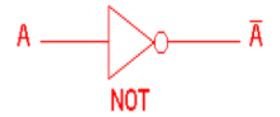
A NOT gate, also known as an inverter, is the simplest digital logic gate with only one input and one output. It performs logical negation: when the input is high (1), the output is low (0), and when the input is low (0), the output becomes high (1).
Presentation of NOT Function Using a Switch
The NOT function can be demonstrated using a simple lamp circuit with two switches arranged in an inverse manner. The first switch represents the logical input (X), and the second represents its inverted state (X). The logical states “0” and “1” correspond to the “Open” and “Closed” positions of the switches respectively.
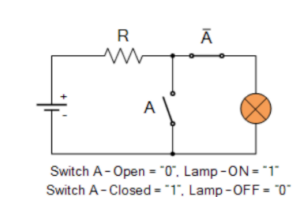
- When the input (X) is TRUE (switch closed), its complement switch (X) is open, and the lamp remains OFF.
- When the input (X) is FALSE (switch open), the complement switch closes, and the lamp turns ON.
These conditions show that the lamp’s state is always inverted relative to the input signal, perfectly demonstrating the Logic NOT function.
Construction of Other Logic Gates Using NOT Gate
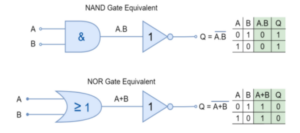
The logic NAND and logic NOR gates can be built by connecting the outputs of logic AND and OR gates to a logic NOT gate. Because NAND and NOR gates can be used to create any other logic function, they are known as Universal Logic Gates.
Cascading two NOT gates restores the original input signal, forming a Digital Buffer.
Construction of Logic NOT Function
The Logic NOT function is widely used in digital circuits and is available in integrated circuit (IC) packages that contain multiple NOT gates. However, since NAND and NOR gates are Universal Gates, they can also be configured to perform the NOT function.
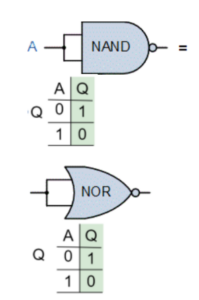
Using a spare NAND or NOR gate to create a NOT function helps save circuit space and cost. This can be done simply by connecting the two inputs of a NAND or NOR gate together, which produces the inversion effect of a NOT gate.
Advantages of Logic NOT Gate
- Inverter circuits are inexpensive to build.
- They operate with very low power consumption.
- They offer high processing speed and reliability.
Disadvantages of Logic NOT Gate
- It has only one output and cannot provide multiple outputs.
- The operational voltage level is limited.
Applications of Logic NOT Function
- Used in CMOS inverters for waveform generation.
- Employed in temperature detection devices.
- Commonly used in smartphones, tablets, and computers.
- Applied in complex digital systems such as decoders, multiplexers, and state machines.
- Used in crystal oscillator circuits to maintain signal stability.