

Introduction
Large industrial establishments involve numerous complex processes that must be monitored continuously. Each machine produces different outputs, making manual monitoring difficult. A SCADA (Supervisory Control and Data Acquisition) system is used to collect data from sensors and instruments located at remote locations.
The collected data is processed by computers and presented in real time. SCADA systems can detect events such as pipeline leakage, trigger alarms, and display information in a structured and organized manner. Earlier SCADA systems operated on DOS and UNIX platforms. This entire mechanism is part of industrial automation.
What is a SCADA System?
SCADA stands for Supervisory Control and Data Acquisition. It is a software-based process control system used to monitor and control industrial processes.

A SCADA system consists of controllers, communication networks, input/output devices, sensors, RTUs, PLCs, and software. It is widely used in manufacturing, oil and gas distribution, water distribution, power generation, transportation systems, and public utilities. SCADA systems automatically read meters, monitor sensor status, and require minimal human intervention.
History of SCADA
Initially, industries relied on manual control using analog instruments, relays, and timers. As industrial complexity increased, automation became necessary.
- 1950s: Computers introduced for industrial control
- 1960s: Telemetry systems developed for data transmission
- 1970s: PLCs and microprocessors introduced
- 2000s: Distributed and networked SCADA systems
- Present: Cloud-based and IoT-enabled SCADA systems
SCADA System Architecture
SCADA is a centralized system that monitors and controls industrial processes. It is a software layer built over hardware components.
The supervisory system collects data from field devices and sends control commands. RTUs and PLCs perform automatic control actions. Operators can modify set points, acknowledge alarms, and monitor performance from a control center.
SCADA systems communicate with client devices using wired and wireless technologies and can control all types of industrial processes.
Hardware Architecture
SCADA hardware architecture is divided into two layers:
- Data Server Layer – Handles data processing and storage
- Client Layer – Handles human-machine interaction
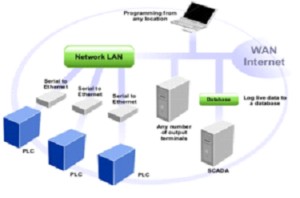
Data servers communicate with PLCs and RTUs via LAN or WAN networks. Sensors connected to PLCs and RTUs collect real-time data, which is converted into digital form and transmitted to the master station.
Software Architecture
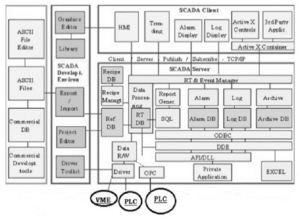
SCADA software supports multitasking and real-time database access. It provides:
- Data acquisition and processing
- Trending and diagnostics
- Alarm management
- Logging and archiving
- Graphical visualization through HMI
Working of SCADA System
SCADA systems perform the following core functions:
- Data Acquisition
- Monitoring and Control
- Data Communication
- Information Presentation
Data Acquisition
Sensors measure parameters such as temperature, pressure, and flow rate. RTUs collect this data and transmit it to the control center.
Data Communication
SCADA uses wired or wireless networks and internet-based protocols. RTUs act as an interface between sensors and communication networks.
Data Presentation
Information is displayed through the Human-Machine Interface (HMI) using graphical symbols, charts, and alarms.
Monitoring and Control
Operators can control devices remotely using switches and commands. SCADA systems can operate automatically but are monitored during critical situations.
Components of SCADA System
- Supervisory System – Central control and communication server
- RTUs – Collect field data and execute control commands
- PLCs – Convert sensor signals into digital data
- Communication Infrastructure – Wired, wireless, LAN, WAN
- HMI – Graphical user interface for monitoring and control
Types of SCADA Systems
- Monolithic SCADA – First-generation, standalone systems
- Distributed SCADA – LAN-based control systems
- Networked SCADA – WAN-based communication systems
- IoT SCADA – Cloud-enabled, real-time monitoring systems
SCADA Security
SCADA security ensures protection against cyber threats such as hackers, malware, and internal errors. Weak security arises from poor training, lack of maintenance, and monitoring gaps.
Difference Between PLC and SCADA
- PLC is hardware-based; SCADA is software-based
- PLC controls machines; SCADA monitors and supervises processes
- PLC uses addresses; SCADA uses graphical names
Advantages of SCADA System
- Improves reliability and efficiency
- Reduces manpower and maintenance cost
- Provides real-time monitoring
- Stores large amounts of data
- Fast response and fault detection
- Highly scalable and flexible
Disadvantages of SCADA System
- High installation cost
- Complex system architecture
- Requires skilled professionals
- Security vulnerabilities
Applications of SCADA
- Power generation and distribution
- Oil and gas industries
- Water and sewage systems
- Manufacturing plants
- Traffic light control systems
- Public transport and buildings
SCADA systems play a vital role in modern industrial automation by enabling efficient monitoring, control, and data-driven decision-making.