

What is a Semiconductor Material?
Semiconductors are materials whose electrical conductivity lies between that of conductors (such as metals) and insulators (such as ceramics). Their conductivity can be controlled and modified, which makes them extremely useful in electronic applications.
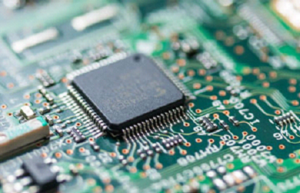
Semiconductors may be pure elements like silicon (Si) or germanium (Ge), or they may be compounds such as gallium arsenide (GaAs) and cadmium selenide (CdSe). By adding small amounts of impurities to pure semiconductors through a process known as doping, significant changes in conductivity can be achieved.
Semiconductors play a vital role in modern electronics. Without them, devices such as radios, televisions, computers, video games, and advanced medical equipment would not exist. Although early electronic devices used vacuum tube technology, advances in semiconductor technology over the last few decades have made devices smaller, faster, more reliable, and energy efficient.
Types of Semiconductor Materials
1. Single-Crystal Semiconductors (Pure Semiconductors)
- Germanium (Ge)
- Silicon (Si)
2. Compound Semiconductors (Compounds of Two or More Elements)
- Gallium Arsenide (GaAs)
- Cadmium Sulfide (CdS)
- Gallium Nitride (GaN)
- Gallium Arsenide Phosphide (GaAsP)
Commonly Used Semiconductor Materials
Germanium (Ge)
Germanium was widely used during the early years of semiconductor development following the invention of the diode in 1939 and the transistor in 1947.
- It was relatively easy to obtain in large quantities
- It could be refined to very high levels of purity
However, germanium-based devices suffered from poor reliability due to their high sensitivity to temperature variations.
Silicon (Si)
Silicon offered improved temperature stability compared to germanium. Although the refinement process was initially challenging, the first silicon transistor was successfully introduced in 1954.
- Less sensitive to temperature changes
- One of the most abundant elements on Earth
- Highly reliable and cost-effective
Due to these advantages, silicon became the dominant semiconductor material and remains the primary building block for integrated circuits and modern processors, including Intel’s processors.
Gallium Arsenide (GaAs)
As electronic systems demanded higher speeds and better performance, gallium arsenide emerged as a suitable alternative semiconductor material.
- The first GaAs transistor was developed in the early 1970s
- Offers operating speeds up to five times faster than silicon
- Widely used in high-frequency and high-speed applications
Atomic Structure of Semiconductors
Semiconductor atoms are bonded together in a regular, periodic crystal structure. The electrons surrounding each atom participate in covalent bonding.
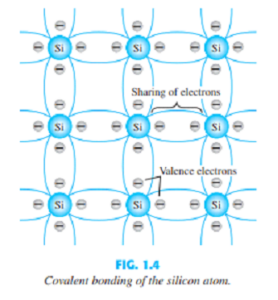
- A covalent bond involves two atoms sharing a pair of electrons
- Each semiconductor atom has four valence electrons
- Each atom is surrounded by eight electrons in its outer shell
Even extremely small amounts of impurities can significantly affect the electrical properties of a semiconductor. Modern semiconductors are among the purest solid materials available.
- In silicon, unintentional impurities are less than 1 atom per 109 silicon atoms
- Deliberately added dopant atoms range from 1 atom per 108 to 103 semiconductor atoms