

Introduction
Solar water heaters, commonly known as solar home hot water systems, are an efficient and economical method
of producing hot water for domestic use. These systems utilize solar energy—an abundant and free natural resource— to heat water, making them environmentally friendly and cost-effective.
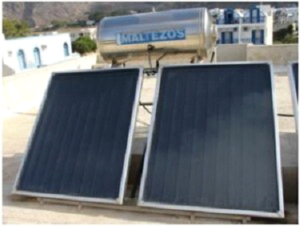
Solar water heating systems are adaptable to different climatic conditions and can be installed in almost any location. They significantly reduce electricity or gas consumption while ensuring a reliable supply of hot water.
Advantages of Solar Water Heater
- Availability of hot water throughout the year: Solar water heaters operate year-round. During winter, when water cools faster, an auxiliary boiler or immersion heater may be used.
- Free of cost energy: These systems use sunlight, which is freely available, eliminating monthly energy costs for water heating.
- No pollution: Solar water heaters are clean and renewable, helping reduce carbon dioxide emissions.
How Solar Water Heater Works
A solar water heater consists of solar collectors (solar panels) and a storage tank, usually installed on the roof.
The collectors absorb solar radiation and convert it into heat, which is transferred to the water stored in the tank.
When sunlight is insufficient, a backup system such as a boiler or immersion heater is used to ensure continuous
hot water supply.
Types of Solar Water Heating Panels
There are mainly two types of solar water heating panels:
- Evacuated tube collectors
- Flat plate collectors (mounted on roof tiles or integrated into the roof)
Large solar panels can also be installed for space heating, but due to low heat output, this method is generally not considered efficient.
Types of Solar Water Heating Systems
Solar water heating systems are classified into two main types:
- Active solar water heating system
- Passive solar water heating system
Active Solar Water Heating System
Active solar heating systems use circulation pumps and control systems to move water or heat-transfer fluids.
Types of Active Systems
- Direct circulation systems: These systems circulate household water directly through the collectors and are suitable for regions where freezing is rare.
- Indirect circulation systems: These systems use a heat exchanger to transfer heat from a non-freezing fluid to the water. They are ideal for cold and freezing climates.
Passive Solar Water Heating Systems
Passive systems are less expensive and more reliable than active systems, though they are slightly less efficient. They do not require pumps or complex controls.
Types of Passive Systems
- Integral Collector-Storage (ICS) systems: Suitable for mild climates, these systems store and heat water in the same unit and provide hot water during both day and night.
- Thermosyphon systems: In these systems, warm water rises naturally while cool water sinks. The collector must be installed below the storage tank. These systems are heavy, so roof strength must be evaluated before installation. They are more expensive than ICS systems.
Storage Tanks and Solar Collectors
The storage tank is one of the most important components of a solar water heater. It includes additional inlet and outlet connections linked to the solar collector. In a two-tank system, water is preheated in the solar tank before entering the conventional heater. In a single-tank system, the solar tank is directly connected to the backup heater.
Types of Solar Collectors for Residential Use
Flat Plate Collectors
Flat plate collectors are available in glazed and unglazed types. Glazed collectors use one or two glass covers and
a dark absorber plate, making them weather-resistant. Unglazed collectors use a black polymer absorber and are
commonly used for swimming pool heating.
Integral Collector Storage Systems
These systems consist of one or more black tanks or tubes enclosed in a glazed box. Water is heated directly inside the collector and then passes through a conventional heater if needed. They are suitable for regions with mild winters.
Evacuated Tube Solar Collectors
Evacuated tube collectors consist of transparent glass tubes containing a metal absorber and heat transfer element. They are highly efficient but more expensive and are commonly used in commercial applications.
Backup System Requirement
During cloudy days or periods of high demand, a backup heating system is required. Conventional storage water heaters are often integrated into solar water heater systems to ensure uninterrupted hot water supply.
Maintenance of Solar Water Heater Systems
Solar water heaters require minimal maintenance. Users should periodically check for water leakage, which can often be detected by visible seepage or unpleasant odor’s. The antifreeze or heat-transfer fluid used for system protection should be inspected and replaced when necessary. Regular usage helps maintain system efficiency and prolongs service life.