
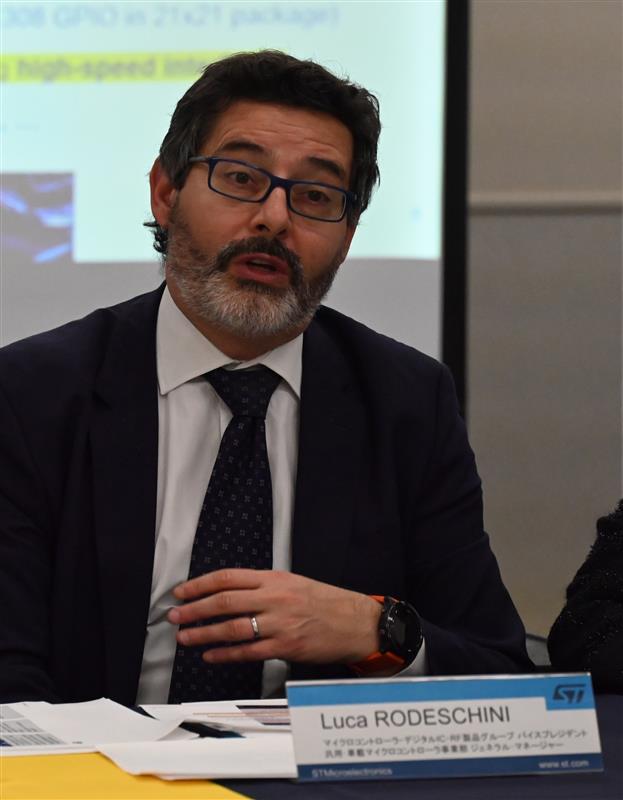
During a virtual media briefing for Asian journalists, attended by Vaishali Umredkar, Editor of Semiconductor For You, Luca Rodeschini, Group Vice President and General Purpose Automotive Microcontrollers Division General Manager, presented Stellar P3E, a new automotive platform combining real-time control, embedded AI acceleration, dense memory, and advanced safety architecture.
This briefing highlighted that STMicroelectronics is positioning the Stellar P3E as the centerpiece of its strategy for the Software-Defined Vehicle (SDV) era. By integrating a dedicated Neural Processing Unit (NPU) into a real-time microcontroller, ST is moving AI from the central “brain” of the car directly into the actuators and power control systems.
“The future automotive controller must combine deterministic control and probabilistic intelligence in one device.”
Q: Vehicle electronics are becoming increasingly complex. Where do you see the biggest engineering challenge today for automakers?
Luca Rodeschini:
The biggest challenge today is managing growing system complexity while keeping innovation fast and cost effective.
Vehicle architectures are evolving rapidly because electrification, connectivity, software growth, safety requirements, and cybersecurity are all advancing at the same time.
At the same time, manufacturers are dealing with supply chain uncertainty and strong competitive pressure from new market entrants.
The industry therefore needs platforms that are powerful, flexible, and secure enough to support long-term development without increasing system fragmentation.
Q: What makes AI a practical advantage in real automotive control rather than just an added feature?
Luca Rodeschini:
AI becomes valuable when it enables functions that traditional algorithms struggle to handle efficiently.
It can detect patterns in complex data, improve prediction accuracy, and support adaptive behavior in real time.
This opens possibilities such as smarter sensing, predictive maintenance, better energy conversion, and more efficient actuation.
The objective is not simply to add AI, but to make vehicle control systems more responsive, reliable, and capable of handling operating conditions that conventional control methods may not fully optimize.
Q: What key automotive trend is Stellar P3E designed to address?
Luca Rodeschini:
The strongest shift we see today is the movement toward integrated vehicle architectures where multiple functions are consolidated into a single electronic control unit. What used to be separated across several controllers now needs to operate together—battery management, inverter control, charging systems, thermal functions, and power distribution.
That level of integration requires a different class of microcontroller. Stellar P3E was designed to combine deterministic control with embedded AI so that control systems become not only faster, but also capable of prediction, classification, and adaptive decision-making.
It delivers 8,000 CoreMark through four independent cores, while two cores can operate in split-lock mode to meet safety requirements.
Q: Why is embedded AI becoming important at the microcontroller level in automotive systems?
Luca Rodeschini:
AI becomes most useful when it is placed where real-time decisions are made.
Traditional central computing platforms are powerful, but they consume much more energy and are not always ideal for localized control tasks. By moving AI to the edge, we can keep intelligence active without constantly relying on central processors.
This matters for functions such as predictive maintenance, onboard charger classification, anti-pinch systems, or hidden motor temperature estimation.
Our Neural ART Accelerator performs neural-network operations locally, minimizing data movement and dramatically reducing power consumption while improving response time.
In some workloads, inference can be up to 69 times faster than running the same model on the CPU.
Q: How does Stellar P3E enable X-in-1 powertrain integration in electric vehicles?
Luca Rodeschini:
X-in-1 architecture is becoming one of the most important design directions in electric mobility.
Previously, each powertrain function required its own controller, its own cooling, housing, and wiring. That adds cost and weight.
With Stellar P3E, OEMs can aggregate those functions into one control platform because we provide very high analog capability, more than 100 ADC channels, and up to 308 GPIOs.
This allows one microcontroller to manage traction systems, onboard charging, DC-DC conversion, and other critical elements simultaneously.
The result is lower weight, reduced cable complexity, fewer expensive connectors, and simplified software deployment.
Q: How does STMicroelectronics differentiate Stellar P3E in addressing long-term software scalability and AI memory demands?
Luca Rodeschini:
Software growth is becoming one of the biggest constraints in automotive development.
That is why we invested heavily in PCM—phase change memory—which gives us very high density embedded non-volatile memory.
Stellar P3E offers up to 19.5 megabytes of embedded memory, which allows customers to maintain OTA capability, integrate multiple software functions, and expand features over time.
This becomes even more important when AI models are added because memory must store those models efficiently without creating latency.
PCM gives us a strong advantage because we can offer larger software capacity without significantly increasing silicon area.
Q: How do you assess the relevance of the Indian market for Stellar P3E and its future adoption potential?
Luca Rodeschini:
India is extremely relevant because performance and cost are both critical there.
Stellar P3E is positioned very well because it supports aggregation while remaining efficient in cost structure.
At the same time, Indian engineering capability in software is very strong. There is a high level of software sophistication, and AI acceleration gives local teams more possibilities to create differentiated vehicle functions.
We are working with local partners and automotive players, and our engineering presence in India is an important strategic advantage.
Q: With connected vehicles becoming more software-driven, how does Stellar P3E address cybersecurity?
Luca Rodeschini:
Cybersecurity must now be built directly into hardware.
Stellar P3E complies with ISO/SAE 21434 and integrates a secure hardware module that creates a root of trust inside the device.
OTA firmware is authenticated through digital signatures before installation, and secure encryption runs independently of the main processor.
We also use internal firewalls so software domains remain isolated.
This is essential when multiple vehicle functions operate on one platform.
Q: What makes 28nm the right technology choice for Stellar P3E?
Luca Rodeschini:
Because automotive requires balance.
Smaller nodes improve pure digital density, but they do not automatically improve analog precision or cost efficiency.
At 28nm we achieve strong analog capability, dense memory integration, and supply resilience.
Another important point is manufacturing control. We produce this node internally, which helps us reduce supply chain dependency.
That is especially important for automotive customers seeking long-term production stability.