
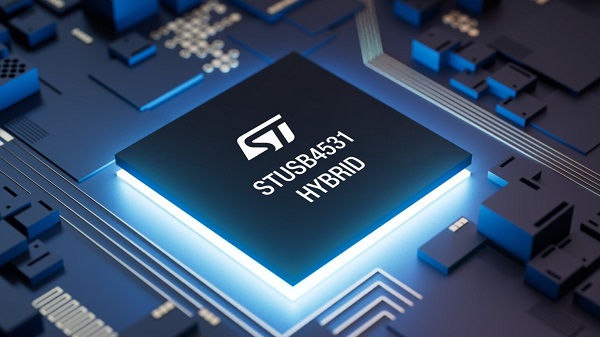
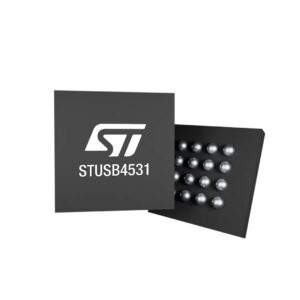
The STUSB4531 is the industry’s first USB PD 3.2 sink controller to offer a hybrid mode, enabling it to send messages without requiring developers to provide a complete protocol implementation through a software stack running on a microcontroller. Our hardwired implementation is more robust and simpler than a traditional sink device using an embedded MCU, while also being flexible and customizable, thanks to a software-based approach that can send messages without requiring a complete protocol stack. It means that direct battery charging applications relying on the programmable power supply (PPS) feature are now far more accessible, as they require less expertise and shorter design Time, since they can be offloaded to a large extent to the new device.
The dilemma between a hardwired and a software implementation
Hardwired
Until today, engineers faced a difficult choice between a hardwired implementation and a full software stack running on a dedicated MCU, communicating with the application on the host MCU. The former is advantageous for dealing with power-critical applications. Indeed, in many cases, the USB Power Delivery (PD) controller must be able to initiate battery charging even when the battery is so low or fully depleted (dead battery mode) that it cannot power the PD controller. It can even be a requirement mandated by regulators in some instances. The challenge is that it is not possible to hardwire a complex application that relies on more intricate messages, which is why this mode is mainly reserved for power management.
Software
On the other hand, a full software stack running on an MCU provides tremendous flexibility. Developers can implement intricate, even proprietary, features, send advanced messages, and create something truly tailored to their needs. The most obvious challenge is that such an implementation requires substantial time and expertise, which are not always readily available. Furthermore, as USB-C® is now ubiquitous, having to use a dedicated MCU as a PD controller may be more problematic. Indeed, it was fine when USB PD was limited to smartphones or other systems with ample large BoMs and fewer constraints. However, we now find these controllers on far more limited systems, which can be a challenge in and of itself.
It’s not getting easier with time
Let’s take the example of a standalone virtual reality headset designed for portability that connects to a laptop to create a virtual environment. In this setup, the USB port must handle high-power requirements, sometimes reaching 100 W, carry data to another USB controller, and then handle the video stream to and from the display port or HDMI controller. That’s a lot of bandwidth, coordination, and complexity for something that may seem as innocuous as watching a 4K movie or reproducing an expansive desktop environment. Engineers have to add a scheduler and low-level implementations on the controllers themselves. Having a vastly simpler sink controller can thus make a world of difference.
STUSB4531: The middle ground, also known as hybrid mode
Hybrid mode
In essence, ST solved this problem by making its low-level hardware more capable, thus offloading certain functions away from the MCU, which then only has to overwrite or extend certain behaviors. Concretely, it means that the STUSB4531 can support programmable power supplies (PPS) contracts, or alternate modes that allow a USB Type-C port to carry non-USB data protocols, such as vendor-defined messages, with minimal software implementation, and certainly without having to write a full stack to run on an MCU. For example, it’s much simpler to create a USB PD 3.2 240 W-compatible product that requires extended message support, as long as engineers implement high-voltage protection and detection.
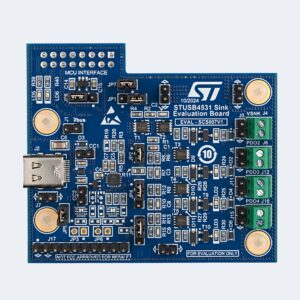
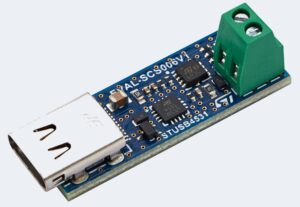
To help take advantage of the Hybrid mode of the STUSB4531, ST will be offering an application note and drivers in the coming months. For now, the STSW-STUSB020 GUI, used in conjunction with the NUCLEO-C071RB or NUCLEO-F072RB and the EVAL-SCS006V1 or EVAL-SCS007V1 evaluation boards, can help configure the non-volatile memory of the STUSB4531, enabling developers to implement power profiles quickly, configure Vbus monitoring, or define application-specific interactions for custom implementations. And a command-line interface (the STSW-STUSB021) helps load or read STUSB4531 configurations, optimizing power users’ workflows. Put simply, our teams have tried to demystify a lot of the work that used to go into creating complex USB-C applications.
Strong foundations
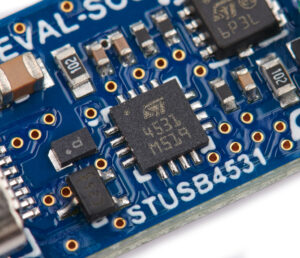
The STUSB4531 offers the same standalone (also called autorun) mode as previous ST USB sink devices, enabling it to negotiate power profiles rapidly, even when the battery level is depleted. But its hardware can also enforce keep-alive messages in a PPS, thus offloading the MCU. In fact, while a PPS has a software component, the STUSB4531’s hardware can handle 80% of it. The device also passes the latest USB-IF and European certifications, reducing the time to market when shipping portable battery-powered devices. Moreover, its small QFN 3 mm x 3 mm and CSP-16 2.3 mm x 2.3 mm packages enable engineers to use some of the smallest footprints available, facilitating PCB layout.