
Introduction
QSL cards are commonly exchanged among amateur radio operators to confirm contacts between two stations or to acknowledge shortwave listener reports. These cards are often considered the final courtesy of a radio contact, and millions of QSL cards are exchanged every year.
While QSL cards are used to prove contacts with specific countries or areas for operating awards, they are also popular collectibles. Many cards come from distant countries or remote islands, making them interesting keepsakes for radio enthusiasts.
What is a QSL Card?
The term QSL comes from the radio “Q” code meaning “I confirm reception.” A QSL card is used to confirm that a radio contact has taken place. These cards are typically postcard-sized and often colorful and eye-catching. Many include photographs of the radio station, the operator, or the surrounding area, which adds to their appeal.
The concept of QSL cards dates back to the early days of long-distance amateur radio communication on shortwave bands. Initially, operators exchanged letters to confirm contacts, but pre-printed cards soon became the preferred method. Although it is not known which station issued the first QSL card, the practice quickly became popular.
Today, ham radio operators send QSL cards for many reasons:
- To remember a special or interesting contact
- To confirm contacts with rare countries or stations
- To collect cards from around the world
- To display them in their radio shack
Some well-known individuals around the world also hold amateur radio licenses, making contacts with them even more memorable.
QSL Cards for Awards
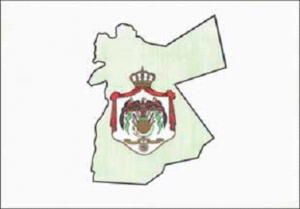
The front and back of a QSL card from King Husssein of Jordan , JY1
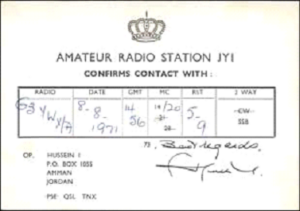
QSL cards are often required when applying for amateur radio awards. One of the most famous awards is the DXCC (DX Century Club) award, issued by the American Radio Relay League (ARRL). It is granted to operators who provide proof of contacts with over 100 different countries.
Additional endorsements may be earned by contacting even more countries. QSL cards serve as official proof of these contacts.
QSL Card Content
A QSL card must include enough information to verify a radio contact. The call sign of the originating station is usually prominently displayed. In addition, the following details are typically included:
- Name and address of the operator: Identifies the station and its location.
- QRA locator: Useful for VHF and UHF operators.
- Island information: Important for operators working toward island-based awards.
- Call sign of the contacted station: Confirms the station involved in the contact.
- Date: The date of the contact.
- Time: Usually given in UTC (Universal Time Coordinated) or GMT.
- Signal report: Indicates signal strength and readability.
- Frequency or band: The operating frequency or band used.
- Mode of operation: For example, SSB, CW, or digital modes.
- Equipment used: Transceiver, antenna, and power details.
- PSE/TNX QSL: Indicates whether a QSL card is requested or acknowledged.
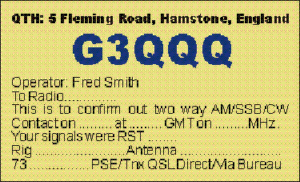
Fortmat of a basic QSL card
Who Uses QSL Cards?
Radio Amateurs
Many amateur radio operators, especially those using HF bands, regularly send QSL cards. Although it is less common for frequencies above 30 MHz, cards are still needed for awards and DX contacts.
Shortwave Listeners
Shortwave listeners often send reception reports to transmitting stations, hoping to receive a QSL card in return. A useful listener report should include:
- Band conditions
- Signal quality
- Other stations heard from the same region
- Any notable signal characteristics
Broadcasting Stations
Some shortwave broadcast stations send QSL cards to listeners who submit accurate reception reports. However, as budgets for HF broadcasting have declined, QSL cards from broadcast stations are becoming less common.
Conclusion
QSL cards are an important tradition in amateur radio. They serve as proof of contact, help operators earn awards, and provide a unique and enjoyable way to collect memories from radio contacts around the world.