

Introduction
A relay is an electromechanical switch that is used to control one or more electrical circuits using a low-power signal. Relays are widely used in various electrical and electronic devices because they allow one circuit to control another circuit without having a direct electrical connection between them.
The basic components of a relay include an electromagnet, an armature, a spring, and a set of electrical contacts. When electrical current flows through the relay coil, it generates a magnetic field that moves the armature, causing the contacts to open or close. A spring returns the armature to its original position when the coil is de-energized.


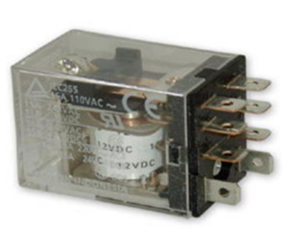


Since the control circuit and the load circuit are connected only through magnetic coupling, relays provide electrical isolation, making them highly reliable and safe for many applications.
What is a Relay?
A relay is an electrically operated switch that uses an electromagnet to control the switching operation of electrical contacts. It allows a low-voltage or low-current circuit to operate a high-voltage or high-current circuit.
When current flows through the relay coil, a magnetic field is created, which attracts the armature and changes the position of the switch contacts. Once the current supply is removed, the armature returns to its original position due to the spring force.
Relays generally have two switch positions and commonly use Single Pole Double Throw (SPDT) or Double Pole Double Throw (DPDT) contact configurations.
Main Relay Contacts
- COM (Common): The common terminal of the relay.
- NO (Normally Open): This contact remains open when the relay coil is not energized.
- NC (Normally Closed): This contact remains connected to the common terminal when the relay coil is not energized.
When the relay coil is energized, the common terminal disconnects from the NC contact and connects to the NO contact.
How Does a Relay Work?
The working principle of a relay is based on electromagnetism. When an electrical current passes through the relay coil, it generates a magnetic field. This magnetic field attracts the armature, causing the relay contacts to change their state.
- If the relay is de-energized, the common contact remains connected to the NC terminal.
- When the relay is energized, the common contact switches to the NO terminal.
- After the coil current is removed, the spring returns the contacts to their original position.
This mechanism enables a low-power control circuit to safely operate high-power electrical loads.
Working of Relay with 3-Coil Configuration
In a three-coil relay arrangement, relays 1 and 2 are connected in series with the coil of relay 3. Relay 3 becomes active only when relays 1 and 2 are energized, indicating the availability of all three phases: R, Y, and B. The output contacts of relay 3 are connected to relay 4. The relay contacts route the three-phase supply to the motor circuit. During motor startup, the normally open contacts of relay 4 create a star connection between motor windings U1-U2, V1-V2, and W1-W2. After a predetermined delay, relay 4 switches the motor connection to delta mode. If single phasing occurs due to the loss of one or more phases, relay 3 deactivates, disconnecting the three-phase supply and protecting the motor from damage.
Working of Relay with 2-Coil Configuration
A two-coil relay is generally called a latching relay and contains two separate coils:
- Set Coil
- Reset Coil
The relay changes state by applying pulse signals alternately to the set and reset coils. Once activated, the relay maintains its position even after the pulse is removed. In telephone interface circuits, such relays are used to control line connections. The relay remains active until a reset pulse is received or a specified timeout period expires.
Working of Relay with 1-Coil Configuration
A single-coil latching relay can maintain either an ON or OFF state using pulse signals of opposite polarity applied to the same coil. Microcontrollers often control relays through relay driver ICs such as the ULN2003 because microcontrollers cannot provide sufficient current to drive relay coils directly.
The ULN2003 consists of multiple Darlington transistor pairs that amplify current and safely drive relay coils. When a logic HIGH signal is applied to the input of the ULN2003, the corresponding output becomes LOW, energizing the relay coil and changing the relay contacts from the normally open position to the normally closed position. When the input becomes LOW, the relay returns to its default state.
Advantages of Relays
- Provide electrical isolation between control and load circuits.
- Allow low-power signals to control high-power devices.
- Highly reliable and durable.
- Offer multiple switching configurations.
- Suitable for automation and protection systems.
- Can operate AC and DC loads.
Disadvantages of Relays
- Mechanical components wear out over time.
- Switching speed is slower compared to semiconductor switches.
- Generate mechanical noise during operation.
- Require more space than solid-state switches.
- Consume power continuously while energized.
Applications of Relays
- Used in modems and audio amplifiers to control high-voltage circuits.
- Used in automobiles to operate starter solenoids and electrical systems.
- Employed in circuit breakers to detect and isolate faults.
- Used in motor protection circuits.
- Applied in industrial automation systems.
- Used in home appliances and control systems.
- Implemented in security and alarm systems.
- Used in timing and delay circuits.
- Employed in telecommunications equipment.
- Used in power transmission and distribution systems.
Conclusion
Relays are essential electromechanical devices used for switching and controlling electrical circuits safely and efficiently. Their ability to isolate circuits, control high-power loads with low-power signals, and provide reliable operation makes them indispensable in industrial automation, automotive systems, telecommunications, and electrical protection applications.