
Introduction
A transfer switch is an electrical device used to switch an electrical load between two power sources, such as the main utility supply and a backup power source. These switches allow power sources to be safely connected to or disconnected from electrical loads. To ensure safe operation, power sources must be properly isolated when not in use, and the transition from one power source to another must occur in a controlled and secure manner. Transfer switches are broadly classified into two types:
- Automatic Transfer Switches (ATS)
- Manual Transfer Switches
Manual transfer switches require human intervention to change the power source, whereas automatic transfer switches perform the switching operation automatically whenever a power failure or restoration is detected.

What is an Automatic Transfer Switch (ATS)?
An Automatic Transfer Switch (ATS) is an electrical switching device that automatically transfers an electrical load from the primary power source to a backup power source whenever it detects a failure in the main supply. When utility power is interrupted, the ATS activates an emergency power source such as a generator or an uninterruptible power supply (UPS) and transfers the electrical load to the backup source without requiring manual intervention.
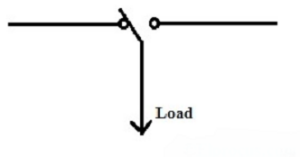
Once normal utility power is restored, the ATS automatically transfers the load back to the primary power source and disconnects the backup supply. An ATS acts as an intelligent electrical relay that continuously monitors incoming power and manages the switching process between power sources.
Automatic Transfer Switch Working Principle
The primary function of an Automatic Transfer Switch is to ensure a seamless and automatic transfer of electrical power between the main power source and a backup source. An ATS is a critical component of an Emergency Power Supply System (EPSS). It continuously monitors voltage, frequency, and power quality through built-in relays and solid-state sensing circuits.
Working Process
- The ATS continuously monitors the incoming utility power supply.
- As long as the voltage and frequency remain within acceptable limits, the ATS keeps the load connected to the utility source.
- If a power outage or voltage drop is detected, the ATS sends a signal to start the backup generator or UPS system.
- Once the backup power source becomes stable, the ATS transfers the electrical load from the utility supply to the backup source.
- When utility power is restored and stabilized, the ATS automatically reconnects the load to the utility supply.
- The backup generator is then disconnected and shut down after a programmed delay period.
Because of this automated operation, ATS systems provide uninterrupted power to critical equipment and facilities.
Automatic Transfer Switch Wiring Diagram
A single-phase Automatic Transfer Switch wiring system typically consists of:
- Magnetic Contactor
- Miniature Circuit Breakers (MCBs)
- Control Wiring
- Utility Power Source
- Generator Power Source
- Load Connection
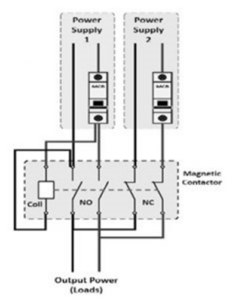
Working of the ATS Wiring Circuit
When utility power is available, electrical current flows through the contactor coil, energizing it and connecting the normally open (NO) contacts. As a result, utility power is supplied directly to the load. When the utility power fails:
- The contactor coil becomes de-energized.
- The normally open contacts disconnect.
- The normally closed (NC) contacts engage.
- The backup generator starts automatically.
- The generator supplies power to the connected load.
Once utility power returns, the ATS automatically transfers the load back to the main supply and disconnects the generator. This automatic switching process ensures continuous power availability while minimizing downtime.
Types of Automatic Transfer Switches
Automatic Transfer Switches are available in different configurations based on their switching mechanism and application requirements.
1. Compact ATS
A Compact ATS, also known as a changeover switch, combines switching and protection functions in a single compact unit.
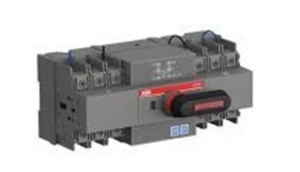
These switches:
- Interrupt short-circuit currents.
- Reduce installation complexity.
- Require fewer wiring connections.
- Offer high reliability and compact design.
Compact ATS units are generally the most expensive type because of their integrated functionality.
2. Circuit Breaker ATS (CB ATS)
Circuit Breaker Automatic Transfer Switches use circuit breakers to transfer power between sources.
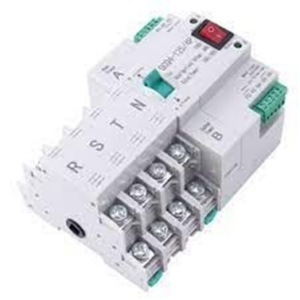
These switches:
- Can make, carry, and interrupt short-circuit currents.
- Use Air Circuit Breakers (ACBs) or Molded Case Circuit Breakers (MCCBs).
- Provide enhanced protection and reliability.
- Allow only one breaker to remain closed at a time through interlocking mechanisms.
CB ATS systems are commonly used in large commercial and industrial installations.
3. Contactor ATS
Contactor-type Automatic Transfer Switches utilize low-voltage contactors to perform switching operations.
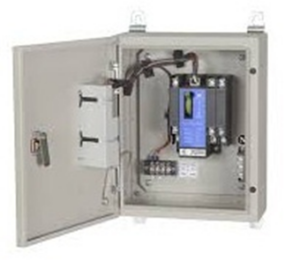
These switches:
- Carry short-circuit currents but do not interrupt them.
- Use 3-pole or 4-pole contactors.
- Provide faster switching than circuit breaker ATS systems.
- Offer a simple and cost-effective design.
- Reduce transfer time significantly.
Contactor ATS units are widely used in residential and small commercial applications due to their affordability.
Advantages of Automatic Transfer Switches
- Automatically transfers electrical loads to backup power sources.
- Ensures uninterrupted power supply during outages.
- Provides fast and reliable switching.
- Includes built-in sensors for monitoring voltage and frequency.
- Offers protection against power fluctuations.
- Reduces downtime for critical systems.
- Improves safety by eliminating manual switching.
- Suitable for generators, UPS systems, and backup power solutions.
- Reliable and easy to operate.
Disadvantages of Automatic Transfer Switches
- More expensive than manual transfer switches.
- Requires periodic maintenance and testing.
- Installation complexity is higher.
- Initial setup costs can be significant.
- System failures may require professional troubleshooting.
Applications of Automatic Transfer Switches
Automatic Transfer Switches are widely used in applications where uninterrupted power supply is essential.
Healthcare Facilities
- Hospitals
- Medical laboratories
- Emergency care centers
Commercial Buildings
- Shopping malls
- Restaurants
- Office complexes
- Hotels
Industrial Facilities
- Manufacturing plants
- Factories
- Warehouses
- Industrial processing units
Telecommunication and Data Centers
- Data centers
- Communication networks
- Financial transaction centers
- Server rooms
Educational Institutions
- Schools
- Colleges
- Universities
ATS systems are also used in generator-to-generator switching, utility-to-utility switching, and multi-source power distribution systems.
Conclusion
An Automatic Transfer Switch (ATS) is a vital component in modern power systems that automatically transfers electrical loads between primary and backup power sources. By ensuring uninterrupted power during outages, ATS units improve reliability, safety, and operational continuity in residential, commercial, industrial, healthcare, and telecommunication applications. Their ability to monitor power conditions and switch automatically makes them an essential part of any emergency power backup system.