
Introduction to TRIAC
A TRIAC (Triode for Alternating Current) is a three-terminal semiconductor device that can conduct current in both directions when triggered. It is widely used in AC power control applications such as dimmers and motor speed controllers.
BT136-600E TRIAC Overview
The BT136-600E is a commonly used TRIAC designed for switching and controlling AC loads. It is compact, efficient, and suitable for low to medium power applications.
Pin Configuration of BT136-600E
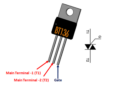
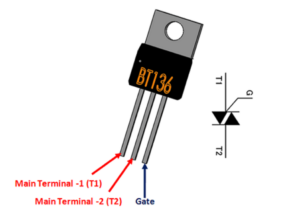
The TRIAC has three terminals:
- Main Terminal 1 (MT1): Connected to phase or neutral of AC mains
- Main Terminal 2 (MT2): Connected to phase or neutral of AC mains
- Gate (G): Used to trigger the TRIAC into conduction
Working Principle
When a small current is applied to the gate terminal, the TRIAC starts conducting between MT1 and MT2. It allows current to flow in both directions and continues conducting until the current falls below the holding current level.
Important Effects in TRIAC Circuits
- Rate Effect: Occurs when the TRIAC switches frequently and sudden high voltage appears across the terminals, affecting performance.
- Backlash Effect: Caused by capacitance between MT1 and MT2, which may lead to unwanted triggering.
- Reverse Current in Inductive Loads: When switching inductive loads, backward current may flow. Therefore, a discharge path (such as a snubber circuit) is required to handle inrush current.
Features of BT136-600E
- Bidirectional current conduction
- Low gate triggering current
- Suitable for AC switching applications
- Compact and cost-effective
- Reliable performance in control circuits
Applications of BT136-600E TRIAC
- AC light dimmers
- AC motor speed control
- Noise coupling and suppression circuits
- Controlling AC loads using microcontrollers (MCU/MPU)
- AC/DC power control systems
- Strobe light control circuits
Conclusion
The BT136-600E TRIAC is a versatile and widely used component for AC power control. Its ability to conduct in both directions and operate efficiently with simple triggering makes it ideal for various electronic applications. Understanding its working and effects ensures better circuit design and performance.