Semiconductor for You
  • Home
  • Semiconductor News
  • Semiconductor Magazine
  • Technology
    • Automotive
    • Consumer Electronics
    • IoT
    • Test and Measurement
    • Lighting
    • Power Management
    • Wireless
    • Personal Electronics
    • Hardware & Software
    • Research
    • Medical Electronics
    • Embedded Design
    • Aerospace & Defence
    • Artificial Intelligence
  • Interview
  • Industries
  • Market
  • Knowledge Base
  • Events
  • Tools
    • Resistor Color Code Calculator
No Result
View All Result
  • Home
  • Semiconductor News
  • Semiconductor Magazine
  • Technology
    • Automotive
    • Consumer Electronics
    • IoT
    • Test and Measurement
    • Lighting
    • Power Management
    • Wireless
    • Personal Electronics
    • Hardware & Software
    • Research
    • Medical Electronics
    • Embedded Design
    • Aerospace & Defence
    • Artificial Intelligence
  • Interview
  • Industries
  • Market
  • Knowledge Base
  • Events
  • Tools
    • Resistor Color Code Calculator
No Result
View All Result
Semiconductor for You
No Result
View All Result
Home Knowledge Base

BT136-600E TRIAC: Pin Configuration, Working, Features, and Applications

Komal Ganvir by Komal Ganvir
April 7, 2026
in Knowledge Base
0
ADVERTISEMENT

Introduction to TRIAC
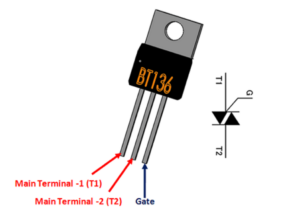
A TRIAC (Triode for Alternating Current) is a three-terminal semiconductor device that can conduct current in both directions when triggered. It is widely used in AC power control applications such as dimmers and motor speed controllers.

ADVERTISEMENT

BT136-600E TRIAC Overview

The BT136-600E is a commonly used TRIAC designed for switching and controlling AC loads. It is compact, efficient, and suitable for low to medium power applications.

Pin Configuration of BT136-600E

The TRIAC has three terminals:

  • Main Terminal 1 (MT1): Connected to phase or neutral of AC mains
  • Main Terminal 2 (MT2): Connected to phase or neutral of AC mains
  • Gate (G): Used to trigger the TRIAC into conduction

Working Principle

When a small current is applied to the gate terminal, the TRIAC starts conducting between MT1 and MT2. It allows current to flow in both directions and continues conducting until the current falls below the holding current level.

Important Effects in TRIAC Circuits

  • Rate Effect: Occurs when the TRIAC switches frequently and sudden high voltage appears across the terminals, affecting performance.
  • Backlash Effect: Caused by capacitance between MT1 and MT2, which may lead to unwanted triggering.
  • Reverse Current in Inductive Loads: When switching inductive loads, backward current may flow. Therefore, a discharge path (such as a snubber circuit) is required to handle inrush current.

Features of BT136-600E

  • Bidirectional current conduction
  • Low gate triggering current
  • Suitable for AC switching applications
  • Compact and cost-effective
  • Reliable performance in control circuits

Applications of BT136-600E TRIAC

  • AC light dimmers
  • AC motor speed control
  • Noise coupling and suppression circuits
  • Controlling AC loads using microcontrollers (MCU/MPU)
  • AC/DC power control systems
  • Strobe light control circuits

Conclusion

The BT136-600E TRIAC is a versatile and widely used component for AC power control. Its ability to conduct in both directions and operate efficiently with simple triggering makes it ideal for various electronic applications. Understanding its working and effects ensures better circuit design and performance.


Tags: BT136-600E TRIACTRIAC
Komal Ganvir

Komal Ganvir

Browse by Category

  • Aerospace and Defence
  • AI & Data Center
  • Articles
  • Automation
  • Automotive
  • Communication
  • Consumer-Electronics
  • Design & Manufacturing
  • Hardware & Software
  • Industrial Electronics
  • Interview
  • IoT
  • Knowledge Base
  • Lighting
  • Market
  • personal-electronics
  • Power Management
  • Research
  • Semiconductor Events
  • Semiconductor News
  • Sensors
  • Technology
  • Test and Measurement
  • Uncategorized
  • Wireless
Semiconductor For You

Semiconductor For You is a resource hub for electronics engineers and industrialist. With its blend of
technology features, news and new product information, Semiconductor For You keeps designers and
managers up to date with the fastest moving industry in the world.

Follow Us

Browse by Category

  • Aerospace and Defence
  • AI & Data Center
  • Articles
  • Automation
  • Automotive
  • Communication
  • Consumer-Electronics
  • Design & Manufacturing
  • Hardware & Software
  • Industrial Electronics
  • Interview
  • IoT
  • Knowledge Base
  • Lighting
  • Market
  • personal-electronics
  • Power Management
  • Research
  • Semiconductor Events
  • Semiconductor News
  • Sensors
  • Technology
  • Test and Measurement
  • Uncategorized
  • Wireless

Recent News

Infineon introduces RIC70115 radiation-hardened GaN HEMT driver for satellite and high-reliability space applications

Infineon introduces RIC70115 radiation-hardened GaN HEMT driver for satellite and high-reliability space applications

July 16, 2026
Cabinet Approves Semicon 2.0 with ₹1.27 Lakh Crore Outlay to Power India’s Semiconductor Future

Cabinet Approves Semicon 2.0 with ₹1.27 Lakh Crore Outlay to Power India’s Semiconductor Future

July 15, 2026
  • About
  • Advertise
  • Privacy & Policy
  • Contact

© 2026 Semiconductor For You

No Result
View All Result
  • Home
  • Semiconductor News
  • Technology
    • IoT
    • Wireless
    • Power Management
    • Automotive
    • Hardware & Software
  • Market
  • Interview
  • Knowledge Base
  • Tools
    • Resistor Color Code Calculator

© 2026 Semiconductor For You

Advertisement