

Introduction
Transformers are one of the most important inventions of the industrial era, as they fulfill various power transmission and distribution requirements across industries. The working principle of a transformer is entirely based on energy transformation through electromagnetic induction.
Faraday extended the theory of electromagnetic induction, which later became the foundation of transformer operation. Early alternating current transformers were developed around 1870, and continuous innovation led to the development of different transformer types such as core type and shell type transformers. This article mainly explains the core type transformer, including its construction, working principle, types, advantages, disadvantages, and applications.
What is a Core Type Transformer?
A core type transformer is a transformer in which the magnetic core is constructed using laminated steel sheets arranged in a rectangular frame. These laminations are generally made in the form of L-shaped strips.
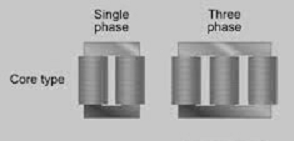
To reduce high magnetic reluctance at the joints, successive layers of laminations are stacked in different orientations so that continuous air gaps are avoided. This arrangement improves magnetic flux distribution and overall transformer efficiency.
Construction of Core Type Transformer
A transformer consists of three main components:
- Magnetic Core
- Primary Winding
- Secondary Winding
The magnetic core is the most important component, as it provides a continuous path for magnetic flux with minimum air gap. The core is made of laminated silicon steel sheets coated with insulating material to reduce losses.
The steel sheets have high permeability and low hysteresis loss. To reduce eddy current losses, the laminations are insulated from each other using oxide layers or varnish coatings. The thickness of laminations varies depending on frequency:
- 0.35 mm for 50 Hz
- 0.5 mm for 25 Hz
To minimize air gaps between layers, laminations are stacked using staggered joints known as imbricated joints. Based on construction, transformers are classified as core type and shell type. Here, we focus on core type construction.
In a core type transformer, the windings surround a considerable portion of the core. The core has a rectangular shape, while the coils may be rectangular or circular. The primary and secondary windings are placed on opposite limbs of the core. For large core type transformers, circular or cylindrical coils are preferred because they offer better mechanical strength compared to rectangular coils. The windings are insulated using paper, cloth, cooling ducts, or micarta boards to ensure electrical isolation and proper cooling. To minimize leakage flux, both windings are placed concentrically, one over the other, using highly insulated cylinders.
Types of Core Type Transformer
Based on the type of lamination used, core type transformers are classified into:
- L-L Laminations
- U-I Laminations
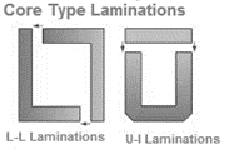
When these laminated stampings are assembled together, the desired core shape is formed. The shape and size of the transformer depend on its rating. For low-rated transformers, square or rectangular cross-sectional cores are used. These shapes are cost-effective and easy to manufacture because the conductors carry low current.
For high-rated transformers, thick conductors are required to carry large currents. In such cases, circular windings are preferred because they ensure better copper utilization and mechanical strength.
However, circular windings on square cores leave unused space between the core and winding. To minimize this, stepped core cross-sections (single, double, or multi-stepped) are used to closely approximate a circular shape.
Advantages of Core Type Transformer
The advantages of core type transformers include:
- Good Mechanical Strength: Cylindrical windings provide excellent mechanical support and durability.
- Reduced Iron Losses: Laminated core construction reduces hysteresis and eddy current losses.
- Low Flux Leakage: Proper stacking of laminations minimizes leakage flux.
- Suitable for High Frequencies: Thin insulated laminations reduce eddy current effects.
- Wide Frequency Range: Efficient operation across various frequencies.
Disadvantages of Core Type Transformer
The disadvantages of core type transformers are:
- Not Suitable for Outdoor Use: Dry-type core transformers are vulnerable to moisture and corrosion.
- Noise Generation: Audible noise due to magnetostriction and vibration of laminations.
- Limited Environmental Protection: External atmospheric conditions can degrade metal parts.
Applications of Core Type Transformer
Core type transformers are widely used in:
- Distribution transformers
- Power transformers
- Auto transformers
- High-voltage transmission and distribution systems
- Indoor power installations
Due to their strong mechanical structure, reduced losses, and efficient performance, core type transformers are commonly used in high-voltage and power distribution applications.