
• Home
  • About Us
  • Contact Us
Semiconductor for You
  • Home
  • Semiconductor News
  • Semiconductor Magazine
  • Technology
    • Automotive
    • Consumer Electronics
    • IoT
    • Lighting
    • Power Management
    • Wireless
    • Personal Electronics
    • Hardware & Software
    • Research
    • Medical Electronics
    • Embedded Design
    • Aerospace & Defence
    • Artificial Intelligence
  • Interview
  • Industries
  • Market
  • Knowledge Base
  • Events
  • Tools
    • Resistor Color Code Calculator
No Result
View All Result
  • Home
  • Semiconductor News
  • Semiconductor Magazine
  • Technology
    • Automotive
    • Consumer Electronics
    • IoT
    • Lighting
    • Power Management
    • Wireless
    • Personal Electronics
    • Hardware & Software
    • Research
    • Medical Electronics
    • Embedded Design
    • Aerospace & Defence
    • Artificial Intelligence
  • Interview
  • Industries
  • Market
  • Knowledge Base
  • Events
  • Tools
    • Resistor Color Code Calculator
No Result
View All Result
Semiconductor for You
No Result
View All Result
Home Articles

Effect of temperature on extrinsic semiconductors

Semiconductor For You by Semiconductor For You
August 11, 2017
in Articles
0

We already know that the addition of a small amount of donor or acceptor impurity produces a large number of charge carriers in an extrinsic semiconductor. In fact, this number is so large that the conductivity of an extrinsic semiconductor is many times that of an intrinsic semiconductor at room temperature.

If the temperature of an N type semiconductor is increased, then since all the donor atoms have already donated their free electrons at room temperature, the additional thermal energy only serves to increase the number of thermally generated carriers.

As a result, the concentration of minority carriers increases. Finally, a temperature is reached when the covalent bonds that are broken is very large so that the number of holes is approximately the same as the number of electrons. The situation with regard to P type semiconductor is also similar. Therefore, the extrinsic semiconductor now behaves essentially like an intinsic semiconductor with higher electrical conductivity. This critical temperature is 850C for germanium and 2000C for silicon and above which it may damage.

Thus, the electrical conductivity of extrinsic semiconductors increases with rise in temperature and such semiconductors have the negative temperature coefficient of resistance.
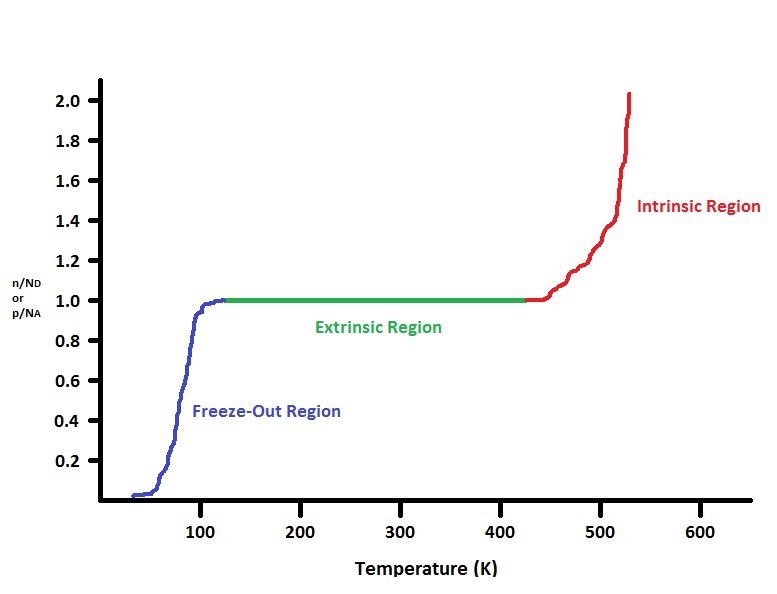

Temperature on extrinsic semiconductors
Content Protection by DMCA.com
Tags: Semiconductors
Semiconductor For You

Semiconductor For You

Browse by Category

  • Aerospace and Defence
  • Articles
  • Automotive
  • Consumer-Electronics
  • Hardware & Software
  • Interview
  • IoT
  • Knowledge Base
  • Lighting
  • Market
  • personal-electronics
  • Power Management
  • Research
  • Semiconductor Events
  • Semiconductor News
  • Technology
  • Wireless
Semiconductor for You

Semiconductor For You is a resource hub for electronics engineers and industrialist. With its blend of
technology features, news and new product information, Semiconductor For You keeps designers and
managers up to date with the fastest moving industry in the world.

Follow Us

Browse by Category

  • Aerospace and Defence
  • Articles
  • Automotive
  • Consumer-Electronics
  • Hardware & Software
  • Interview
  • IoT
  • Knowledge Base
  • Lighting
  • Market
  • personal-electronics
  • Power Management
  • Research
  • Semiconductor Events
  • Semiconductor News
  • Technology
  • Wireless

Recent News

Former Apple CEO Gilbert Amelio Joins Future Form Manufacturing Executive Advisory Board

Former Apple CEO Gilbert Amelio Joins Future Form Manufacturing Executive Advisory Board

December 10, 2025
TDK unveils physical AI technologies that enhance devices and experiences — “In Everything, Better” at CES 2026

TDK unveils physical AI technologies that enhance devices and experiences — “In Everything, Better” at CES 2026

December 10, 2025
  • About
  • Advertise
  • Privacy & Policy
  • Contact

© 2022 Semiconductor For You

No Result
View All Result
  • Home
  • Semiconductor News
  • Technology
    • IoT
    • Wireless
    • Power Management
    • Automotive
    • Hardware & Software
  • Market
  • Knowledge Base
  • Tools
    • Resistor Color Code Calculator

© 2022 Semiconductor For You