

Introduction to Communication
Communication is the process of sharing information from one person or place to another through a suitable medium. In everyday life, humans communicate using sound waves that travel through the air.
Long-Distance Communication
For long-distance communication, wireless communication systems such as mobile phones are widely used. In wireless communication, information is transmitted through electromagnetic (EM) waves.


What is an Antenna?
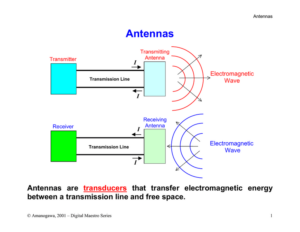


An antenna is an electronic device that converts electrical signals into electromagnetic waves and transmits them through space. It enables wireless communication by sending and receiving information over long distances without the need for physical wires. Thus, an antenna acts as a bridge between electrical circuits and free-space electromagnetic waves.
Working of an Antenna
The information to be transmitted is first converted into electrical signals. These electrical signals are then applied to a transmitter, which converts them into electromagnetic waves. The power supplied to the antenna is generally in the form of Radio Frequency (RF) energy. For wireless communication, two antennas are required:
- Transmitting Antenna
- Receiving Antenna
1. Transmitting Antenna
A transmitting antenna converts electrical signals into electromagnetic waves and radiates them into space. It is the primary source of Radio Frequency (RF) radiation and an essential element of radio communication systems. The antenna consists of a conductor carrying an alternating current whose magnitude varies with time. This varying current generates electromagnetic waves that propagate through space.
2. Receiving Antenna
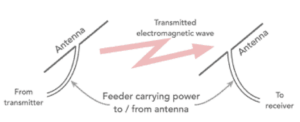

A receiving antenna performs the opposite function of a transmitting antenna. It receives electromagnetic waves transmitted through space and converts them back into electrical signals. These electrical signals are then processed by the receiving communication equipment to recover the original information.
Basic Principle of Antenna Operation
The operation of antennas is based on Maxwell’s Equations, which describe the behavior of electric and magnetic fields.
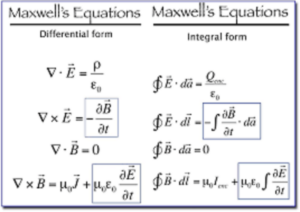

Maxwell’s equations form the foundation of electromagnetic theory and provide the mathematical basis for:
- Wireless communication systems
- Radio and television transmission
- Radar systems
- Electric motors and generators
- Optical devices and lenses
- Power generation and transmission
Characteristics of Antenna
1. Radiation Pattern
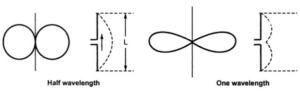

A practical antenna cannot radiate energy equally in all directions. The distribution of radiated energy around an antenna is known as its radiation pattern. Radiation is generally strongest in one direction and weakest or nearly zero in others. The radiation pattern is represented using field strength, which is measured at a specific distance from the antenna.
2. Directivity
Directivity is a measure of how effectively an antenna concentrates radiated power in a particular direction. It is defined as the ratio of maximum power density to average power density. Mathematically:
:contentReference[oaicite:0]{index=0}
- An isotropic antenna radiates equally in all directions and has D = 1.
- All practical antennas have D > 1.
- An omnidirectional antenna radiates equally in all directions within a plane.
3. Polarization
Polarization refers to the orientation of the electric field component of an electromagnetic wave radiated by an antenna.
Radio waves may be:
- Linear Polarized
- Circular Polarized
- Elliptically Polarized
- Non-Polarized
4. Antenna Efficiency
Antenna efficiency is the ratio of the total power radiated by the antenna to the total electrical power supplied to it. Mathematically:
:contentReference[oaicite:1]{index=1}
An ideal antenna has 100% efficiency. However, practical antennas typically achieve efficiency between 50% and 60%.
5. Bandwidth
Bandwidth is the range of frequencies over which an antenna can operate effectively while maintaining acceptable performance. A wider bandwidth allows the antenna to transmit and receive a broader range of signals.
6. Antenna Array
An antenna array is a systematic arrangement of multiple antennas operating together as a single unit. The antennas are usually identical and placed at fixed distances from each other. Antenna arrays provide:
- Higher directivity
- Improved gain
- Better beam control
- Reduced interference
- Enhanced communication performance
Applications of Antennas
- Mobile communication systems
- Radio broadcasting
- Television transmission
- Satellite communication
- Radar systems
- Wireless networking (Wi-Fi)
- Navigation systems
- Military communication systems
Advantages of Antennas
- Enable wireless communication
- Support long-distance transmission
- Reduce the need for physical cables
- Provide high-speed data communication
- Used in a wide variety of communication systems
Conclusion
An antenna is a vital component of modern wireless communication systems. It converts electrical signals into electromagnetic waves for transmission and converts received electromagnetic waves back into electrical signals. Understanding antenna fundamentals, working principles, and characteristics is essential for designing efficient communication systems.