
The demand for advanced capabilities in entry-level microcontrollers continues to evolve as embedded systems become increasingly complex. The introduction of the STM32C5 by STMicroelectronics represents a significant step forward by providing enhanced performance, connectivity, and security at an affordable price point, which were typically sacrificed for low-cost solutions.
For markets like India, where scale and cost sensitivity go hand in hand, this shift could enable a new wave of feature-rich, high-volume embedded applications.
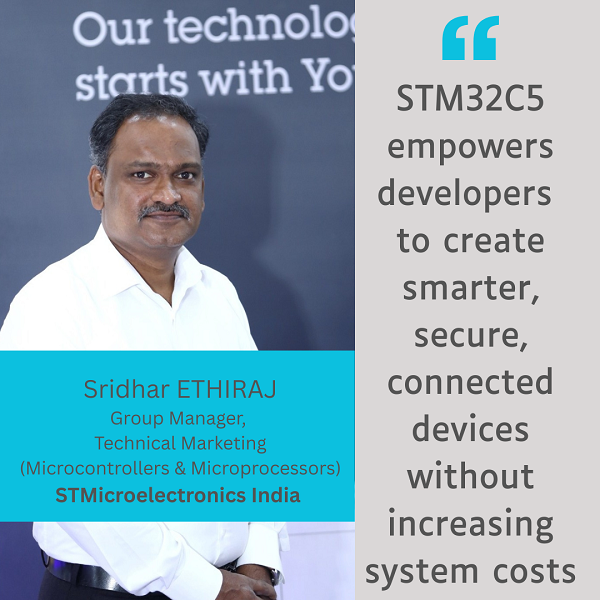
Interview Q&A with Mr. Sridhar ETHIRAJ, Group Manager – Technical Marketing (Microcontrollers & Microprocessors), STMicroelectronics India.
1. The STM32C5 brings Cortex-M33 to entry-level MCUs—what enabled higher performance without increasing cost?
The STM32C5 was designed to deliver higher performance without shifting the cost curve.

Using ST’s 40nm process and concentrating on providing exactly the correct amount of performance, the STM32C5 introduces the Cortex-M33 core, along with many additional MHz (clock speed) and memory (RAM) without increasing the overall cost of the device. Therefore, the STM32C5 emphasises architectural optimisations and integration rather than over-specifying the part.
Hence, it enables functions traditionally associated with mid-range MCUs but at an entry-level price, allowing developers to achieve more capabilities without moving across the cost scale.
2. From a product designer’s perspective, how does this series simplify hardware design or reduce BOM?
Hardware complexity as well as overall system cost are minimized by the STM32C5.
By using a simple single-LDO power architecture, having a built-in Ethernet MAC, and having several security features built into the product, much of the need for multiple external components is eliminated. This reduces the total number of components, PCB footprint, and also decreases design time required to develop.
In addition, the ability to use features such as Ethernet and emulated EEPROM, which are normally not found at this level, gives designers more capability in designing their product without increasing their BOM.
3. What applications do you expect Indian developers to build with this MCU that were earlier difficult at this price point?
We anticipate that there will be significant uptake of our technology in all types of applications – industrial, infrastructure, and consumer.
Use cases like motor control systems, industrial sensors, EV charging solutions and IoT gateways will be able to take advantage of enhanced compute performance and integration at an increasingly affordable price point.
This allows developers to create a more responsive, connected and secure device while continuing to meet the price requirements for high volume markets.
4. How does the STM32 ecosystem help designers—especially startups and SMEs—accelerate prototyping and reduce time-to-market?
The STM32C5 supports the STM32Cube ecosystem which includes a number of enhancements with the release of Cube 2.0. This ecosystem provides tools for developers including STM32CubeMX, optimized HAL Drivers, and production-grade middleware to allow developers to complete concepts to prototype cycles quickly.
This system also provides evaluation boards, reference designs and reusable software therefore reducing time spent on development.
Startups and SMEs will benefit from faster prototyping, less risk of development and a shorter time-to-market.
5. What security and scalability features are built into this series for IoT and industrial use cases?
Security is integrated at both hardware and system levels in the STM32C5.
The series includes hardware cryptographic accelerators, secure boot, and memory protection features, enabling developers to build secure connected devices from the outset. Combined with the Cortex-M33 architecture, this supports robust and reliable system design.
From a scalability perspective, the STM32 platform offers strong pin compatibility and software reuse, allowing developers to efficiently migrate across product tiers with minimal redesign.