

What is a Photo Resistor?
A Photo Resistor, also known as a Light Dependent Resistor (LDR), is a passive electronic component whose resistance changes according to the intensity of light falling on its surface.
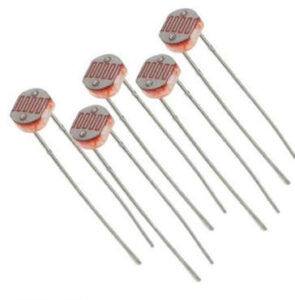

The term can be understood as:
- Photo – Related to light and photons
- Resistor – A device that opposes the flow of electric current
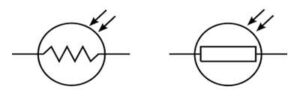
Therefore, a Photo Resistor is a device that uses light as an input and changes its resistance accordingly.
Working Principle of Photo Resistor
The resistance of a photo resistor depends on the amount of light falling on it and is inversely proportional to light intensity.
- High light intensity → Low resistance
- Low light intensity → High resistance
When light falls on the light-sensitive surface of the photo resistor, photons transfer energy to the electrons present in the material. These energized electrons become free to move, increasing the conductivity of the device and allowing more current to flow. As the number of incident photons increases, more electrons are released, resulting in:
- Higher current flow
- Lower resistance
Because of this property, a photo resistor is also known as a photoconductive device.
Characteristics of Photo Resistor
- Resistance decreases as light intensity increases.
- Resistance increases in darkness.
- It is a passive electronic component.
- It is highly sensitive to light.
- Its resistance varies with temperature.
- Its operation depends on the wavelength of incident light.
Temperature Effect on Photo Resistor
A photo resistor is also temperature-sensitive.
Even when the intensity of incident light remains constant, changes in temperature can affect the resistance value of the device.
Therefore, both light intensity and temperature influence the performance of a photo resistor.
Wavelength Dependence
A photo resistor responds only to a specific range of light wavelengths.
Different photo resistors are designed to operate efficiently within particular wavelength ranges, making them suitable for specific sensing applications.
Basic Circuit of Photo Resistor
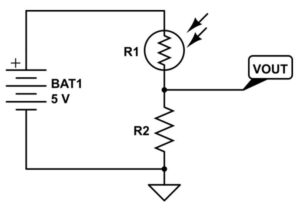
A photo resistor is generally connected in series with a fixed resistor to form a voltage divider circuit.
As the light intensity changes, the resistance of the photo resistor changes, causing the output voltage of the circuit to vary accordingly.
Application: Electronic Letter Box
One practical application of a photo resistor is an Electronic Letter Box. The photo resistor is placed inside the letter box where it continuously receives light. When a letter is dropped into the box:
- The light falling on the photo resistor is blocked.
- The sensor detects darkness.
- The resistance increases.
- A circuit activates an indicator light or alarm.
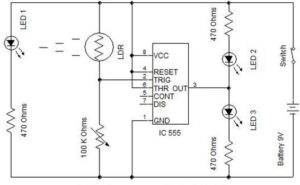
This indicates that a letter has been delivered and is present inside the mailbox.
Applications of Photo Resistor
- Automatic street lighting systems
- Electronic letter boxes
- Solar panels and solar tracking systems
- Camera flash control circuits
- Robotics and automation systems
- Light-sensitive alarms
- Brightness control circuits
- Security systems
Advantages of Photo Resistor
- Simple construction
- Low cost
- High sensitivity to light
- Easy to interface with electronic circuits
- Low power consumption
Disadvantages of Photo Resistor
- Slow response compared to photodiodes
- Affected by temperature changes
- Less accurate in high-speed applications
- Limited wavelength sensitivity range
Conclusion
A Photo Resistor (LDR) is a light-sensitive passive component whose resistance changes according to the intensity of incident light. Due to its simplicity, low cost, and high sensitivity, it is widely used in automatic lighting systems, electronic letter boxes, cameras, robotics, and various light-sensing applications.