
• Home
  • About Us
  • Contact Us
Semiconductor for You
  • Home
  • Semiconductor News
  • Semiconductor Magazine
  • Technology
    • Automotive
    • Consumer Electronics
    • IoT
    • Lighting
    • Power Management
    • Wireless
    • Personal Electronics
    • Hardware & Software
    • Research
    • Medical Electronics
    • Embedded Design
    • Aerospace & Defence
    • Artificial Intelligence
  • Interview
  • Industries
  • Market
  • Knowledge Base
  • Events
  • Tools
    • Resistor Color Code Calculator
No Result
View All Result
  • Home
  • Semiconductor News
  • Semiconductor Magazine
  • Technology
    • Automotive
    • Consumer Electronics
    • IoT
    • Lighting
    • Power Management
    • Wireless
    • Personal Electronics
    • Hardware & Software
    • Research
    • Medical Electronics
    • Embedded Design
    • Aerospace & Defence
    • Artificial Intelligence
  • Interview
  • Industries
  • Market
  • Knowledge Base
  • Events
  • Tools
    • Resistor Color Code Calculator
No Result
View All Result
Semiconductor for You
No Result
View All Result
Home Articles

What is transistor shunt regulator?

Semiconductor For You by Semiconductor For You
July 8, 2017
in Articles
0

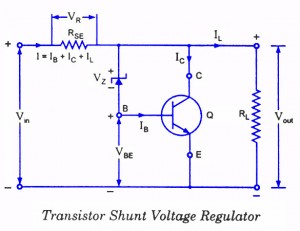
Transistor shunt voltage regulator

The above figure shows the circuit diagram of transistor shunt regulator where the transistor is connected in shunt (parallel) with the load hence the circuit is called transistor shunt regulator.

The zener voltage VZ of zener diode is reverse biased by the unregulated DC voltage. To limit the zener current a resistor R1 is connected in series with a zener diode. A transistor Q1 is connected in shunt with the load resistor RL is used as controlling device and its function is to shunt part of the supply current from the load.

The transistor must pass the current all the time it is operating, for a shunt regulator to perform an efficiently. It may be noted from the circuit that the load voltage VOut is equal to the sum of zener voltage and the base to emitter voltage VBE of a transistor.

VOut = VZ + VBE          OR         VBE = VOut -VZ

There is the voltage for given diode is fixed; therefore any increase or decrease in load voltage will have a corresponding effect on the voltage VBE.


Content Protection by DMCA.com
Tags: Semiconductorstransistor
Semiconductor For You

Semiconductor For You

Browse by Category

  • Aerospace and Defence
  • Articles
  • Automotive
  • Consumer-Electronics
  • Hardware & Software
  • Interview
  • IoT
  • Knowledge Base
  • Lighting
  • Market
  • personal-electronics
  • Power Management
  • Research
  • Semiconductor Events
  • Semiconductor News
  • Technology
  • Wireless
Semiconductor for You

Semiconductor For You is a resource hub for electronics engineers and industrialist. With its blend of
technology features, news and new product information, Semiconductor For You keeps designers and
managers up to date with the fastest moving industry in the world.

Follow Us

Browse by Category

  • Aerospace and Defence
  • Articles
  • Automotive
  • Consumer-Electronics
  • Hardware & Software
  • Interview
  • IoT
  • Knowledge Base
  • Lighting
  • Market
  • personal-electronics
  • Power Management
  • Research
  • Semiconductor Events
  • Semiconductor News
  • Technology
  • Wireless

Recent News

Vishay Intertechnology Extends 193 PUR-SI Series of Snap-in Power Aluminum Capacitors With Voltage Ratings of 550 V and 600 V

Vishay Intertechnology Extends 193 PUR-SI Series of Snap-in Power Aluminum Capacitors With Voltage Ratings of 550 V and 600 V

January 15, 2026
VIAVI Expands Edge Monitoring Platform with New Sensor Options to Meet Diverse Private Network Assurance Operating Environments

VIAVI Expands Edge Monitoring Platform with New Sensor Options to Meet Diverse Private Network Assurance Operating Environments

January 15, 2026
  • About
  • Advertise
  • Privacy & Policy
  • Contact

© 2022 Semiconductor For You

No Result
View All Result
  • Home
  • Semiconductor News
  • Technology
    • IoT
    • Wireless
    • Power Management
    • Automotive
    • Hardware & Software
  • Market
  • Knowledge Base
  • Tools
    • Resistor Color Code Calculator

© 2022 Semiconductor For You