


Introduction
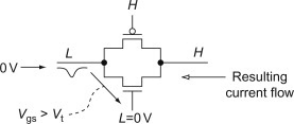
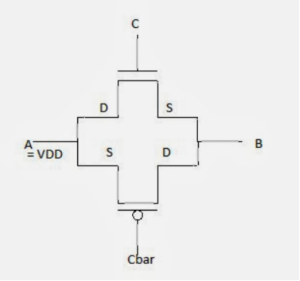
A Transmission Gate (TG) is an analog switch that can conduct signals in both directions or block signals depending on the control input. It is widely used in CMOS digital and analog circuits for signal switching applications. A transmission gate consists of a parallel combination of:
- An NMOS transistor
- A PMOS transistor
The NMOS transistor passes a strong logic 0 but a weak logic 1, while the PMOS transistor passes a strong logic 1 but a weak logic 0. By connecting both transistors in parallel, the transmission gate can pass both logic levels efficiently without signal degradation. The gate terminals of the PMOS and NMOS transistors are driven by complementary control signals.


- NMOS Gate → Control Signal (C)
- PMOS Gate → Complement of Control Signal (C̅)


Basic Structure of Transmission Gate
A transmission gate acts as a bidirectional switch between two nodes, usually represented as Node A and Node B. Its operation depends on the control signal:
- C = 1 (HIGH) → Both NMOS and PMOS turn ON.
- C = 0 (LOW) → Both NMOS and PMOS turn OFF.
When both transistors are ON, a low-resistance path exists between the input and output terminals. When both are OFF, a high-impedance path exists, effectively disconnecting the circuit.
Working Principle of Transmission Gate
A transmission gate operates as an electronic switch that selectively passes or blocks analog and digital signals.
Case 1: Control Signal HIGH (C = 1)
When the control signal is HIGH:
- NMOS transistor turns ON.
- PMOS transistor also turns ON because its gate receives the complement signal.
- A low-resistance path is established between nodes A and B.
- The signal is transmitted from input to output.
Because both transistors conduct simultaneously, the transmission gate passes both logic HIGH and logic LOW signals without significant attenuation.
Case 2: Control Signal LOW (C = 0)
When the control signal is LOW:
- NMOS transistor turns OFF.
- PMOS transistor turns OFF.
- The path between nodes A and B becomes an open circuit.
- No signal transmission occurs.
The output enters a high-impedance (High-Z) state.
Signal Transmission Through Transmission Gate
Passing Logic HIGH
When the input signal is logic HIGH (VDD):
- PMOS transistor remains fully conductive.
- NMOS transistor may begin to weaken as the output voltage approaches VDD.
- PMOS ensures the logic HIGH level is transmitted without degradation.
Therefore, the transmission gate passes a strong logic HIGH.
Passing Logic LOW
When the input signal is logic LOW (0V):
- NMOS transistor remains fully conductive.
- PMOS assists conduction.
- The logic LOW level is transmitted without attenuation.
Therefore, the transmission gate passes a strong logic LOW.
High-Impedance State
When both transistors are OFF, the transmission gate behaves like an open switch. This creates a high-impedance (High-Z) condition, meaning:
- No current flows between input and output.
- The connected circuits become electrically isolated.
- The output remains disconnected from the input signal.
Interfacing Considerations
Care must be taken when transmission gates are connected to dynamic or precharged logic circuits. Potential issues include:
- Charge sharing between nodes
- Noise coupling
- Unwanted discharge of dynamic nodes
- Possible latch-up conditions
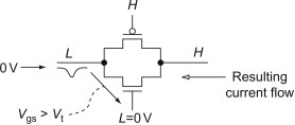

Proper circuit design is required to avoid these problems in high-speed CMOS systems.
Advantages of Transmission Gate
- No degradation of output logic levels.
- Can pass both logic HIGH and logic LOW efficiently.
- Bidirectional signal transmission.
- Lower propagation delay.
- Higher switching sensitivity.
- Suitable for both analog and digital applications.
Disadvantages of Transmission Gate
- Requires both NMOS and PMOS transistors.
- Needs complementary control signals.
- Increases circuit complexity.
- Parallel transistors increase node capacitance.
- Consumes more chip area than a single transistor switch.
Applications of Transmission Gate
- D Latches
- D Flip-Flops
- Multiplexers (MUX)
- Demultiplexers (DEMUX)
- Sample-and-Hold Circuits
- CMOS Logic Circuits
- Memory Circuits
- Analog Signal Switching
- Hot-Swap and Hot-Insertion Systems
- Security and Access-Control Systems
Conclusion
A Transmission Gate is a CMOS-based bidirectional switch formed by connecting NMOS and PMOS transistors in parallel. It provides efficient transmission of both logic HIGH and logic LOW signals without degradation. Due to its low propagation delay, high reliability, and bidirectional operation, the transmission gate is widely used in digital logic circuits, memory systems, multiplexers, latches, flip-flops, and analog switching applications.