
Introduction
A pulse transformer is one of the most widely used custom transformers in various industrial and electronic applications. In general, vacuum and power electronic devices operate using high-power pulse voltages, which are generated by pulse transformers. These transformers are compact in structure and provide excellent repeatability.
In most applications, a wide pulse width, short rise time, and high energy efficiency are required. Pulse transformers are mainly designed to handle large loads for power distribution. Compared to standard transformers of similar size, they can transmit large amounts of power while operating at high frequencies.
Due to these characteristics, pulse transformers are extensively used in many industrial fields. This article presents an overview of pulse transformers and their working principle.
What is a Pulse Transformer?
A pulse transformer is a type of transformer that is specifically designed and optimized to transmit voltage or current pulses between its primary and secondary windings and to the connected load.
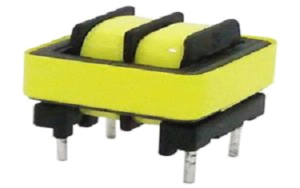
These transformers are commonly used for signal transmission in low-power control circuits and as critical components in high-power switched-mode power supplies (SMPS). Pulse transformers are also used as isolation transformers in power electronic circuits to electrically separate the source from the load.
The main functions of a pulse transformer are:
- Changing the amplitude of voltage pulses
- Changing pulse polarity
- Coupling different stages of pulse amplifiers
- Providing electrical isolation
Pulse Transformer Design
The design of a pulse transformer depends on several parameters such as inductance, power rating, impedance, voltage levels, size, operating frequency, frequency response, winding capacitance, and packaging. Transformer designers aim to minimize parasitic elements like leakage inductance and inter-winding capacitance by optimizing winding arrangements and improving magnetic coupling between windings.
Pulse transformers are generally small in size and require fewer turns, resulting in low leakage inductance and reduced inter-winding capacitance. Their cores are usually made of ferrite materials, which provide high magnetizing inductance and prevent saturation at high frequencies.
These transformers also offer high-voltage insulation between windings and toward the ground. Small pulse transformers are commonly used in pulse generators, computers, and electronic devices, whereas large pulse transformers are used in radar systems to deliver power levels of 50–100 MW at voltages of 200–300 kV for very short durations.
Types of Pulse Transformers
Pulse transformers are mainly classified into two types:
Power Pulse Transformers
Power pulse transformers are used to switch power-level voltages. They are available with single-phase or three-phase primary designs depending on application requirements.
Signal Pulse Transformers
Signal pulse transformers transmit data signals between different circuits using electromagnetic induction. The voltage transformation depends on the turns ratio of the windings.
Construction and Working Principle
The primary function of a pulse transformer is to generate gate or control signals for semiconductor devices while providing electrical isolation. A pulse transformer typically consists of a toroidal core with primary and secondary windings.
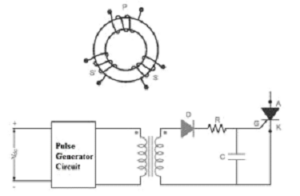
- All windings have equal turns, allowing any winding to act as primary or secondary.
- Gate signals can be applied to SCRs in ratios such as 1:1 or 1:1:1.
- A three-winding pulse transformer can supply continuous gate signals.
- A series resistor is used to limit the holding current of the rectifier.
- A diode is used to prevent reverse gate current.
To reduce magnetizing current, the primary winding inductance must be high. Proper insulation between windings ensures safety, while tight coupling improves performance. At high frequencies, stray capacitance affects signal transmission.
For high-frequency signals, the output waveform closely matches the input waveform, ensuring accurate pulse reproduction.
Specifications of Pulse Transformer
The key specifications of a pulse transformer determine the allowable pulse distortion and output response:
- Pulse Amplitude: Maximum peak value of the output pulse excluding noise spikes.
- Rise Time (Tr): Time taken for the pulse to rise from 10% to 90% of peak amplitude.
- Overshoot: Portion of the output pulse that exceeds its peak value.
- Pulse Width: Time interval between points where amplitude reaches 50% of peak value.
- Droop: Gradual reduction in pulse amplitude during the flat portion of the pulse.
- Fall Time (Tf): Time taken for pulse amplitude to fall from 90% to 10%.
- Backswing: Portion of the trailing edge that goes below zero amplitude.
Applications of Pulse Transformer
- Pulse generating circuits
- Analog switching applications
- SCR firing circuits
- Power electronics
- Data handling circuits
- Radar systems
- Switching transistors
- Communication systems
- Microwave tube circuits
- Cathode ray tube (CRT) circuits
- Digital electronics
Advantages and Disadvantages
Advantages
- Small size and compact design
- High isolation voltage
- Low cost
- No external power supply required
- Operates efficiently at high frequencies
- Capable of transmitting high energy pulses
- Provides insulation and control
Disadvantages
- Output waveforms differ at low frequencies
- DC supply through primary winding is required to prevent core saturation
- Saturates at lower frequencies
- Signal distortion due to magnetic coupling