

Introduction
Electromagnetic induction is an efficient method of generating electricity and is widely used from power generation to power transmission. In this phenomenon, a voltage or electromotive force (EMF) is produced across a conductor due to a changing magnetic field or magnetic flux.
The theory of electromagnetic induction is based on Faraday’s laws and Lenz’s law, discovered by Michael Faraday and Emil Lenz in 1830. Electromagnetic induction can be produced in two ways: by placing a conductor in a moving magnetic field or by moving a conductor inside a stationary magnetic field.
What is Lenz’s Law?
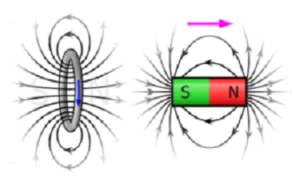
Lenz’s law was formulated by the scientist Emil Lenz. According to Lenz’s law, the direction of the induced current in a conductor is such that the magnetic field produced by the induced current always opposes the change in magnetic flux that produced it. In other words, when current is induced in a conductor due to a changing magnetic field, the induced magnetic field acts against the original magnetic field.
Relationship Between Faraday’s Law and Lenz’s Law
Faraday’s law states that a changing magnetic field induces an electromotive force in a conductor. Lenz’s law defines the direction of this induced EMF. This opposition is represented by the negative sign in Faraday’s equation.
Faraday’s Law:
ϵ = −dΦB/dt
The magnetic field can be varied by changing its strength or by moving a magnet toward or away from the conductor. The magnitude of the induced EMF is directly proportional to the rate of change of magnetic flux.
ε ∝ dΦ/dt
Lenz’s Law Formula
Lenz’s law is mathematically expressed using Faraday’s law of electromagnetic induction as:
EMF = −N (ΔΦ / Δt)
Where:
- EMF = Induced voltage or electromotive force
- N = Number of turns in the coil
- ΔΦ = Change in magnetic flux
- Δt = Change in time
Lenz’s Law and Conservation of Energy
Lenz’s law is a direct consequence of the law of conservation of energy. If the induced current
produced a magnetic field in the same direction as the original magnetic field, it would lead
to an increase in energy without any external work, violating energy conservation.
Therefore, the induced current always produces a magnetic field that opposes the original
field change. This opposition prevents infinite energy generation and ensures energy balance.
Experimental Verification of Lenz’s Law
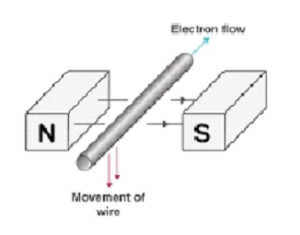
Emil Lenz verified his law using several experiments to determine the direction of induced current.
First Experiment
When current flows through a coil, magnetic field lines are produced. An increase in current increases the magnetic flux, and the induced current opposes this increase.
Second Experiment
An induced current is produced when a current-carrying coil is wound over an iron rod and moved toward another coil. The induced current direction opposes the magnetic field causing the motion.
Third Experiment
When a coil is pulled in the direction of magnetic flux, it experiences a force that opposes the motion. This confirms that the induced current produces a magnetic field opposing the external magnetic field.
Lenz’s Law Problems and Solutions
Problem 1
A horizontal coil of 350 turns and radius 7.5 cm is placed in a magnetic field given by B(t) = 0.02t2. Find the induced EMF as a function of time.
EMF = −N × A × (dB/dt)
= −350 × (22/7 × 0.0752) × (2 × 0.02t)
= −25t V
The induced current flows in the clockwise direction.
Problem 2

The direction of induced current in a metallic loop will be such that it opposes the change produced by the current flowing through a nearby wire. Therefore, the induced current in the loop flows in the clockwise direction.
Problem 3
For a circular loop rotating with angular velocity ω in a uniform magnetic field B:
ΦB = BA cos(ωt)
Induced EMF:
ϵ = −dΦB/dt = BAω sin(ωt)
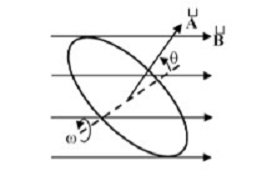
Induced current:
I = ϵ / R = (BAω / R) sin(ωt)
Advantages of Lenz’s Law
- Helps determine the direction of induced current
- Based on the law of conservation of energy
- Applicable to both AC and DC circuits
- Explains the opposition between induced EMF and flux change
- Fundamental concept in electromagnetism
Limitations of Lenz’s Law
- Opposes magnetic flux change but does not quantify the magnitude of EMF
- Requires Faraday’s law for numerical calculations
Applications of Lenz’s Law
- Electric and AC generators
- Electromagnetic braking systems
- Induction cooktops
- Inductors and transformers
- Metal detectors
- Electromagnetic dynamometers
- Microphones used in railway braking systems
- Smart cards and reader cards