Semiconductor for You
  • Home
  • Semiconductor News
  • Semiconductor Magazine
  • Technology
    • Automotive
    • Consumer Electronics
    • IoT
    • Test and Measurement
    • Lighting
    • Power Management
    • Wireless
    • Personal Electronics
    • Hardware & Software
    • Research
    • Medical Electronics
    • Embedded Design
    • Aerospace & Defence
    • Artificial Intelligence
  • Interview
  • Industries
  • Market
  • Knowledge Base
  • Events
  • Tools
    • Resistor Color Code Calculator
No Result
View All Result
  • Home
  • Semiconductor News
  • Semiconductor Magazine
  • Technology
    • Automotive
    • Consumer Electronics
    • IoT
    • Test and Measurement
    • Lighting
    • Power Management
    • Wireless
    • Personal Electronics
    • Hardware & Software
    • Research
    • Medical Electronics
    • Embedded Design
    • Aerospace & Defence
    • Artificial Intelligence
  • Interview
  • Industries
  • Market
  • Knowledge Base
  • Events
  • Tools
    • Resistor Color Code Calculator
No Result
View All Result
Semiconductor for You
No Result
View All Result
Home Knowledge Base

How resistor works

Shatabdi Pantawane by Shatabdi Pantawane
June 25, 2021
in Knowledge Base
0
ADVERTISEMENT

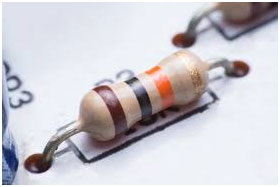
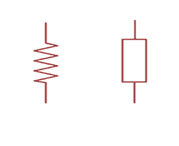
A resistor is a passive electrical component with the primary function to oppose the flow of charge of current. It is considered to be the most used and the most important component of all the electronic circuits.

Working of Resistor

The working of a resistor can be explained by the similarity of water flowing through a pipe. Consider a pipe through which water is flowing. If the diameter of the pipe is reduced, the flow of water will be reduced. If the force of the water is increased by increasing the pressure, then the energy will be dissolute as heat. Therefore, there will also be an enormous difference in pressure in the head and end of the pipe. In this example, the force applied to the water is similar to the current flowing through the resistance. The pressure applied can be resembled the voltage.

ADVERTISEMENT

Unit of resistance

  • The SI-unit of resistance (R) is Ohm [Ω].
  • The higher multiple and sub-multiple values of ohm are kilo ohms [KΩ], megaohms [MΩ], milli ohm and so on. 
  • It is denoted by “R”.
  • The SI-unit of resistance (R) is Ohm [Ω].
  • The higher multiple and sub-multiple values of ohm are kilo ohms [KΩ], megaohms [MΩ], milli ohm and so on. 
  • It is denoted by “R”.

Resistors in Series 

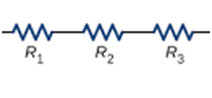
  • In many cases, two or more resistors are connected in the circuit. The simplest way to connect them all is a series connection. In a series connection, the resistors are connected in series and the current flowing through the resistor will be the same. The voltage across the resistors will be equal to the sum of voltages across each resistor.
  • Three resistors R1, R2, and R3 are connected in series. The total resistance Total is given by
  •   R total = R1 + R2 + R3

Resistors in Parallel

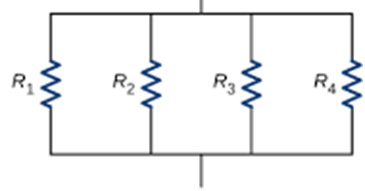
  • In many cases, two or more resistors are connected in the circuit. In a parallel connection, the resistors are connected in parallel and the voltage applied across each component will be the same. The current across the resistors will be equal to the sum of currents across each resistor.
  •  Three resistors R1, R2, and R3 are connected in parallel. The total resistance R total is given by
  •  1/Rtotal = 1/ R1 + 1/ R2 + 1/ R3 + 1/R4
  • Therefore, Rtotal = R1 * R2 * R3 * R4 / R1 + R2 + R3 + R4
Power Dissipated in a Resistor

  • The equation for the power dissipation of a resistor is given by
  • Power, P = I­2 * R = V * I = V2 /R
  •  Uses of Resistors
  • Used in an electronic circuit to keep the circuit in the right condition.
  • Used in several sensor applications.
  • Used for spike and surge protection.
  • Electrical equipment like heater rods, kettle, iron, bulb, remote control, mobile chargers, TV sets, hairdryers, etc.




Shatabdi Pantawane

Shatabdi Pantawane

Browse by Category

  • Aerospace and Defence
  • AI & Data Center
  • Articles
  • Automation
  • Automotive
  • Communication
  • Consumer-Electronics
  • Design & Manufacturing
  • Hardware & Software
  • Industrial Electronics
  • Interview
  • IoT
  • Knowledge Base
  • Lighting
  • Market
  • personal-electronics
  • Power Management
  • Research
  • Semiconductor Events
  • Semiconductor News
  • Sensors
  • Technology
  • Test and Measurement
  • Uncategorized
  • Wireless
Semiconductor For You

Semiconductor For You is a resource hub for electronics engineers and industrialist. With its blend of
technology features, news and new product information, Semiconductor For You keeps designers and
managers up to date with the fastest moving industry in the world.

Follow Us

Browse by Category

  • Aerospace and Defence
  • AI & Data Center
  • Articles
  • Automation
  • Automotive
  • Communication
  • Consumer-Electronics
  • Design & Manufacturing
  • Hardware & Software
  • Industrial Electronics
  • Interview
  • IoT
  • Knowledge Base
  • Lighting
  • Market
  • personal-electronics
  • Power Management
  • Research
  • Semiconductor Events
  • Semiconductor News
  • Sensors
  • Technology
  • Test and Measurement
  • Uncategorized
  • Wireless

Recent News

Description of Antenna Tuner or Antenna Tuning

Description of Antenna Tuner or Antenna Tuning

July 25, 2026
Caliber Interconnects Showcases AI-Driven Semiconductor Testing Leadership at IEEE ITC India 2026 Bengaluru, India

Caliber Interconnects Showcases AI-Driven Semiconductor Testing Leadership at IEEE ITC India 2026 Bengaluru, India

July 25, 2026
  • About
  • Advertise
  • Privacy & Policy
  • Contact

© 2026 Semiconductor For You

No Result
View All Result
  • Home
  • Semiconductor News
  • Technology
    • IoT
    • Wireless
    • Power Management
    • Automotive
    • Hardware & Software
  • Market
  • Interview
  • Knowledge Base
  • Tools
    • Resistor Color Code Calculator

© 2026 Semiconductor For You