
Semiconductor for You
  • Home
  • Semiconductor News
  • Semiconductor Magazine
  • Technology
    • Automotive
    • Consumer Electronics
    • IoT
    • Test and Measurement
    • Lighting
    • Power Management
    • Wireless
    • Personal Electronics
    • Hardware & Software
    • Research
    • Medical Electronics
    • Embedded Design
    • Aerospace & Defence
    • Artificial Intelligence
  • Interview
  • Industries
  • Market
  • Knowledge Base
  • Events
  • Tools
    • Resistor Color Code Calculator
No Result
View All Result
  • Home
  • Semiconductor News
  • Semiconductor Magazine
  • Technology
    • Automotive
    • Consumer Electronics
    • IoT
    • Test and Measurement
    • Lighting
    • Power Management
    • Wireless
    • Personal Electronics
    • Hardware & Software
    • Research
    • Medical Electronics
    • Embedded Design
    • Aerospace & Defence
    • Artificial Intelligence
  • Interview
  • Industries
  • Market
  • Knowledge Base
  • Events
  • Tools
    • Resistor Color Code Calculator
No Result
View All Result
Semiconductor for You
No Result
View All Result
Home Knowledge Base

Flame Sensor : Working & Its Applications

Nikita Bisen by Nikita Bisen
August 9, 2022
in Knowledge Base
0
ADVERTISEMENT
  • A flame sensor is used to detect fire or flame in the wavelength range of 760nm-1100nm from the light source.
  • The flame sensor is easily damaged to high frequency that why this sensor can be placed at a certain distance from the flame.
  • This sensor detection can be 100cm distance and angle will be 600 and the output will be a digital or analog signal.
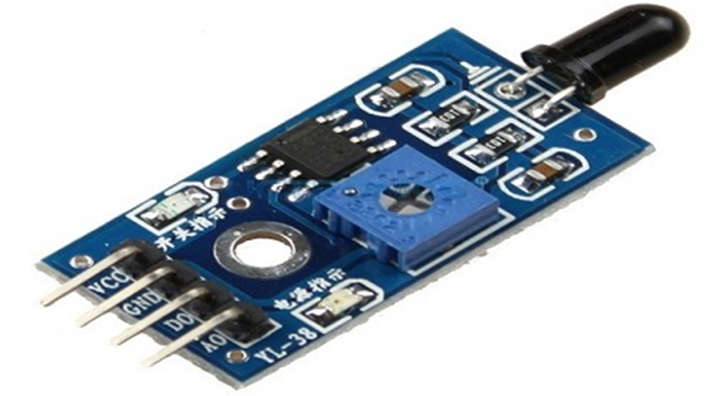
Flame Sensor
    1. Pin1 (VCC pin): Voltage supply rages from 3.3V to 5.3V
    2. Pin2 (GND): This is a ground pin
    3. Pin3 (AOUT): This is an analog output pin (MCU.IO)
    4. Pin4 (DOUT): This is a digital output pin (MCU.IO)

Working of Flame Sensor

  • This detector can be constructed with an electronic circuit using a receiver like electromagnetic radiation.
  • Flame sensors employ the infrared flame flash method. It allows the sensor to work through a coating of oil, dust, water vapor, and ice.
  • A flame sensor is based on the YG1006 sensor which is a high-speed and high-sensitive NPN silicon phototransistor.

Application of Flame Sensor

  • Flame sensors are used in different places like Hydrogen stations, Industrial heating, Fire Detection, Fire alarm, Fire fighting robot, Drying systems, Industrial gas turbines, Domestic heating systems, and Gas-powered cooking devices.

ADVERTISEMENT

Nikita Bisen

Nikita Bisen

Browse by Category

  • Aerospace and Defence
  • AI & Data Center
  • Articles
  • Automation
  • Automotive
  • Communication
  • Consumer-Electronics
  • Design & Manufacturing
  • Hardware & Software
  • Healthcare
  • Industrial Electronics
  • Interview
  • IoT
  • Knowledge Base
  • Lighting
  • Market
  • personal-electronics
  • Power Management
  • Research
  • Robotics
  • Semiconductor Events
  • Semiconductor News
  • Sensors
  • Technology
  • Test and Measurement
  • Uncategorized
  • Wireless
Semiconductor For You

Semiconductor For You is a resource hub for electronics engineers and industrialist. With its blend of
technology features, news and new product information, Semiconductor For You keeps designers and
managers up to date with the fastest moving industry in the world.

Follow Us

Browse by Category

  • Aerospace and Defence
  • AI & Data Center
  • Articles
  • Automation
  • Automotive
  • Communication
  • Consumer-Electronics
  • Design & Manufacturing
  • Hardware & Software
  • Healthcare
  • Industrial Electronics
  • Interview
  • IoT
  • Knowledge Base
  • Lighting
  • Market
  • personal-electronics
  • Power Management
  • Research
  • Robotics
  • Semiconductor Events
  • Semiconductor News
  • Sensors
  • Technology
  • Test and Measurement
  • Uncategorized
  • Wireless

Recent News

Infineon collaborates with MediaTek to enable future automotive smart cockpit solutions

Infineon collaborates with MediaTek to enable future automotive smart cockpit solutions

August 6, 2026
Behind the Robot: Sensing, Safety, and Control in Industry 4.0

Behind the Robot: Sensing, Safety, and Control in Industry 4.0

August 6, 2026
  • About
  • Advertise
  • Privacy & Policy
  • Contact

© 2026 Semiconductor For You

No Result
View All Result
  • Home
  • Semiconductor News
  • Technology
    • IoT
    • Wireless
    • Power Management
    • Automotive
    • Hardware & Software
  • Market
  • Interview
  • Knowledge Base
  • Tools
    • Resistor Color Code Calculator

© 2026 Semiconductor For You