
Introduction
A squirrel cage induction motor normally operates with full line voltage using a Direct-On-Line (DOL) starter. However, this method draws a very high starting current, which may damage the motor windings and cause voltage dips in the power system.
To overcome this problem, an Autotransformer Starter is used. It is a reduced-voltage starting method mainly employed for three-phase induction motors. This starter effectively reduces the inrush current while providing sufficient starting torque, making it suitable for heavy industrial loads.

What is an Autotransformer Starter?
An autotransformer starter is a motor starting device used to reduce the voltage applied to the motor during starting. Large motors draw excessive current at startup, which can cause voltage drops and disturb other electrical equipment connected to the same supply.
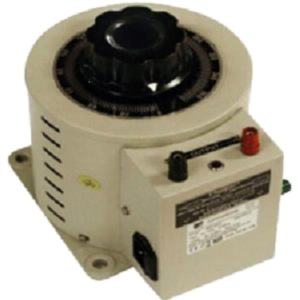
Since voltage and current are directly proportional, reducing the applied voltage also reduces the starting current. One effective way to reduce the voltage is by using an autotransformer. The motor is supplied with a reduced voltage during startup until it reaches its normal operating speed. After that, full line voltage is applied directly to the motor.
Unlike a conventional transformer, an autotransformer has a single winding that acts as both the primary and secondary. It has multiple taps, typically providing 50%, 65%, or 80% of the rated voltage. Due to its simple construction, an autotransformer starter is lighter, more efficient, and less expensive than a two-winding transformer starter. Its primary function is to reduce the starting current to the square of the voltage ratio.
Principle of Autotransformer Starter
The working principle of an autotransformer starter is based on reduced voltage starting. Initially, the motor is connected to the autotransformer through selected taps, which supply reduced voltage. When switches 1 and 2 are closed, the motor receives reduced voltage from the autotransformer. This limits the starting current and reduces the motor torque, allowing smooth acceleration.
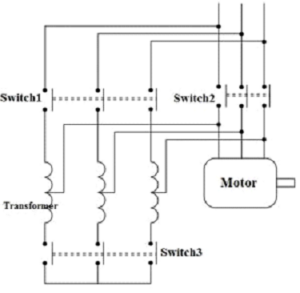
As the motor speed increases and reaches a stable value, switch 2 is opened. At this stage, the autotransformer windings act as inductors connected in series with the motor. After a short time delay, switch 1 is opened and switch 3 is closed. This connects the motor directly to the full supply voltage. The motor then reaches its rated speed and operates normally. The autotransformer is disconnected from the circuit.
Theory of Autotransformer Starter
The autotransformer starter can be used with any squirrel cage induction motor. The motor is connected to the secondary side of the autotransformer during starting. Different tap settings (50%, 65%, or 80%) provide reduced voltage to the motor. Because of this, the motor current is reduced proportionally, and the line current is reduced even further.
For example, if the motor is connected to a 50% voltage tap:
- Motor starting current is reduced to 50%.
- Line current is reduced to 25%.
This difference between motor current and line current is due to transformer action. As a result, the autotransformer starter provides higher starting torque per ampere of line current than other reduced-voltage starters.
Advantages of Autotransformer Starter
The main advantages of an autotransformer starter include:
- Significant reduction in inrush current.
- Adjustable starting voltage using transformer taps.
- Lower line current compared to motor current.
- High starting torque per ampere of supply current.
- Suitable for large motors and heavy loads.
- Efficient operation with better voltage regulation.
- Requires less copper compared to conventional transformers.
- High efficiency and reduced power losses.
Disadvantages of Autotransformer Starter
The disadvantages of an autotransformer starter are:
- Lower power factor during starting.
- Higher cost due to the autotransformer.
- Bulky size, making installation difficult in limited spaces.
- Circuit complexity compared to other starters.
Applications of Autotransformer Starter
Autotransformer starters are widely used in various electrical and industrial applications, such as:
- Reduced voltage starting of induction motors.
- Starting large squirrel cage and slip-ring induction motors.
- Starting synchronous motors.
- Used as voltage boosters at the end of long transmission lines.
- Laboratory testing equipment.
- Voltage regulation in AC feeders.
- Interconnecting systems operating at different voltage levels.
- Starting heavy-duty industrial machines.
Due to its ability to provide high starting torque with reduced current, the autotransformer starter is one of the most efficient and reliable starting methods for large electric motors.