

Introduction
Every amateur (ham) radio station is assigned a unique call sign. These callsigns are used to identify each station around the world. Since radio signals can travel across countries and continents, a standard identification system is essential.
When radio communication was first developed, it quickly became clear that a structured system was needed to organize transmissions. As a result, call signs were assigned to all radio stations, including amateur stations.

Even today, many radio services rely on call signs. Maritime and aeronautical services, for example, use them to identify stations. Although systems like cellular phones and Wi-Fi do not use traditional call signs, they still rely on unique identifiers to route data and voice communications correctly.
Ham Radio Callsign Structure
All amateur radio call signs follow an internationally agreed structure. This structure allows the station and its country of origin to be identified. Although different services may use slightly different formats, the basic principle remains the same. A typical ham radio call sign consists of two main parts:
- Prefix
- Call sign serial characters (suffix)

Prefix
The prefix is the first part of the call sign. It includes all characters up to and including the number. The prefix usually contains up to three characters.
Examples:
- In G3YWX, the prefix is G3.
- In VP8ANT, the prefix is VP8.
- In 2E9QQQ, the prefix is 2E9.
Suffix (Serial Characters)
The letters following the prefix form the suffix. These characters act as the station’s unique identifier. The suffix usually contains one to three letters. Most modern call signs have three-letter suffixes, but in countries with fewer stations, one- or two-letter suffixes may still be used. Some very old call signs also have shorter suffixes.
Countries, Prefixes, and Call Signs
Each country is assigned specific prefixes for its radio call signs. By checking the prefix, it is possible to identify the country—and sometimes even the region— where the station is located.
Examples:
- G3YWX – The prefix G indicates England.
- VP8ANT – The prefix VP8 is used for remote
South Atlantic and Antarctic regions.
During contests or special events, stations may use special prefixes to attract attention. These special calls still fall within the internationally assigned prefix ranges.
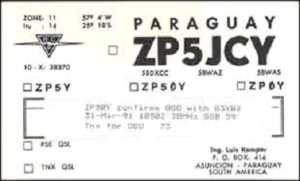
QSL card showing the contest ham radio callsign ZP50Y
Call Sign Area Codes
In some countries, authorities divide call sign blocks into regions. This makes it possible to identify the area where the station is located. For example, in the United States, the number in the call sign often represents a specific geographic region. Canada and several other countries use similar systems to identify station locations.
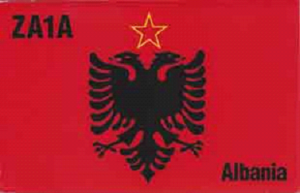
QSL card showing the callsign ZA1A ( Albania )
Ham Radio Call Sign Suffixes
Additional suffixes are often added to call signs to indicate the station’s operating condition or location.
- /M – Mobile (operating from a vehicle)
- /P – Portable operation
- /MM – Maritime mobile
- /AM – Aeronautical mobile
Operating from Other Countries
Many radio amateurs operate from different countries while traveling. If the stay is long-term, a new call sign is usually issued by the host country. For short visits, the operator may use their home call sign combined with the country prefix. Older practice placed the prefix after the call sign, such as:
- G3YWX/VP9 – Operating in Bermuda
Modern international regulations recommend placing the country prefix before the call sign:
- F/G3YWX – Operating in France
Conclusion
Ham radio call signs are essential for identifying stations worldwide. Their structured format allows operators to recognize both the station and its country of origin. Understanding call sign structure, prefixes, and suffixes helps amateur radio operators communicate more effectively and follow international operating practices.