

Introduction
Sensor technology has significantly improved the quality of human life through its wide range of applications in various fields. Sensors are devices that detect changes in the environment and convert them into signals that can be measured and processed.

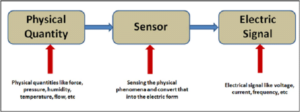
They can detect physical parameters such as temperature, light, motion, pressure, and sound. These signals are then processed by electronic systems to produce useful outputs.
What are Sensors?
A sensor is a device, module, or subsystem that detects changes in its environment and converts them into electrical signals. These signals are further processed by a microprocessor or control system to generate meaningful output. Sensors convert physical phenomena into measurable digital signals that can be displayed, analyzed, or used for automation.
Working of Sensors
Sensors capture physical parameters such as temperature, pressure, speed, or motion and convert them into electrical signals. These signals are processed by a microprocessor to produce the desired output.
Depending on the system complexity, multiple sensors may be used together to improve functionality and accuracy.
Types of Sensors
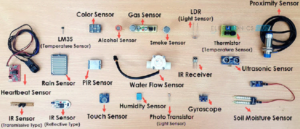
There are many types of sensors used for different applications. Some common types include:
- Temperature sensors
- Pressure sensors
- Proximity sensors
- Optical sensors
- Motion sensors
- Humidity sensors
- Gas and chemical sensors
- Level sensors
- Infrared sensors
- Accelerometer and gyroscope sensors
Sensors in Daily Life
Sensors are widely used in everyday devices and systems. They make our lives easier, safer, and more efficient. Common examples include:
- Smartphones (motion sensors, proximity sensors, light sensors)
- Refrigerators and air conditioners (temperature and humidity sensors)
- Washing machines (water level and load sensors)
- Automobiles (parking sensors, airbag sensors, rain sensors)
- Automatic doors and lighting systems
- Smart street lights and motion-based lighting systems
Modern vehicles use advanced sensors for features like automatic braking, lane detection, and self-driving systems.
Applications of Sensors
1. Smart Homes and Buildings
Sensors are used in smart home systems to control lighting, temperature, and security systems automatically.
2. Healthcare
Sensors monitor vital parameters such as heart rate, temperature, and blood flow, improving patient care.
3. Industrial Applications
Sensors are used to monitor machines, detect faults, and improve efficiency in manufacturing processes.
4. Environmental Monitoring
Sensors help detect pollution levels, temperature changes, and environmental conditions.
5. Smart Cities
Acoustic and environmental sensors are used to monitor noise pollution, traffic, and urban conditions.
Importance of Sensors
- Improve automation and efficiency
- Enhance safety and monitoring
- Enable smart technologies
- Support data-driven decision making
Conclusion
Sensors play a vital role in modern technology and daily life. From household appliances to advanced industrial systems, they help monitor, control, and improve processes. As technology continues to evolve, sensors will become even more important in creating smarter and more efficient systems.