
Introduction
A feedback amplifier is an electronic amplifier in which a portion of the output signal is fed back to the input through a feedback path. This feedback mechanism helps control the overall behavior and performance of the amplifier. The feedback factor (β) is defined as the ratio of the feedback signal to the input signal.
What is Feedback Amplifiers?
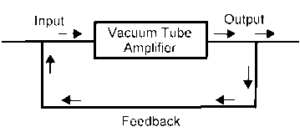

Feedback is the process of returning a fraction of the output energy of a system back to its input. It is mainly used to improve stability, reduce noise, and ensure consistent amplifier performance.
Types of Feedback Amplifiers
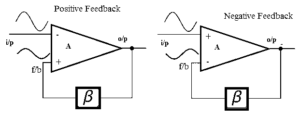
Based on how the feedback signal interacts with the input, feedback amplifiers are classified into two main types:
- Positive Feedback Amplifier
- Negative Feedback Amplifier
Positive Feedback Amplifier
In a positive feedback amplifier, the feedback signal is applied in such a way that it increases the input signal. It is also known as regenerative or direct feedback.
Positive feedback is rarely used in amplifiers because it can cause instability and distortion. However, it is widely used in oscillator circuits, where it helps generate continuous signals.
Negative Feedback Amplifier
In a negative feedback amplifier, the feedback signal opposes the input signal. This improves stability, reduces distortion, and enhances bandwidth.
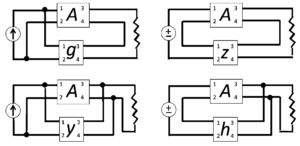
Negative feedback amplifiers are further classified into four types based on how voltage or current is fed back (series or parallel connection):
- Voltage Series Feedback Amplifier
- Voltage Shunt Feedback Amplifier
- Current Series Feedback Amplifier
- Current Shunt Feedback Amplifier
1. Voltage Series Feedback Amplifier
In this configuration, a portion of the output voltage is fed back in series with the input signal.
- Input resistance increases
- Output resistance decreases
2. Voltage Shunt Feedback Amplifier
In this type, a portion of the output voltage is fed back in parallel (shunt) with the input signal.
- Input resistance decreases
- Output resistance decreases
3. Current Series Feedback Amplifier
Here, a portion of the output current is fed back in series with the input signal.
- Input resistance increases
- Output resistance increases
4. Current Shunt Feedback Amplifier
In this configuration, a portion of the output current is fed back in parallel with the input signal.
- Input resistance decreases
- Output resistance increases
Amplifier Characteristics with Negative Feedback
| Feedback Topology | Input Resistance | Output Resistance |
|---|---|---|
| Voltage Series | Increases (Rif = Ri(1 + Aβ)) | Decreases (Rof = Ro / (1 + Aβ)) |
| Current Series | Increases (Rif = Ri(1 + Aβ)) | Increases (Rof = Ro(1 + Aβ)) |
| Current Shunt | Decreases (Rif = Ri / (1 + Aβ)) | Increases (Rof = Ro(1 + Aβ)) |
| Voltage Shunt | Decreases (Rif = Ri / (1 + Aβ)) | Decreases (Rof = Ro / (1 + Aβ)) |
Advantages of Feedback Amplifiers
- Stabilizes amplifier gain
- Reduces noise and distortion
- Improves bandwidth
- Can increase input resistance (depending on configuration)
- Can reduce output resistance (in specific configurations)
Disadvantages of Feedback Amplifiers
- Reduces overall gain of the amplifier
Applications of Feedback Amplifiers
- Electronic amplifiers
- Regulated power supplies (RPS)
- Wide bandwidth amplifiers