

Introduction
A Binary Subtractor is a digital circuit used to perform subtraction between binary numbers. It is designed similarly to a binary adder but performs the opposite operation. In binary subtraction, three bits may be involved for each subtraction operation:
- Minuend (Xi) – The number from which another number is subtracted.
- Subtrahend (Yi) – The number to be subtracted.
- Borrow Input (Bi) – Borrow received from the previous lower-order bit.
The outputs generated are:

- Difference (Di)
- Borrow Output (Bi+1)
Subtractor circuits accept two binary numbers as inputs and subtract one number from another. Similar to adders, subtractors produce two outputs: Difference and Borrow.
Types of Binary Subtractors
- Half Subtractor
- Full Subtractor
Binary Half Subtractor
A Half Subtractor is a combinational logic circuit that performs subtraction between two single-bit binary numbers.
Block Diagram:
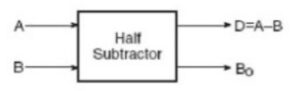
It has:
- Two inputs: A (Minuend) and B (Subtrahend)
- Two outputs: Difference (D) and Borrow (Bo)
Truth Table of Half Subtractor
| A | B | D | Bo |
|---|---|---|---|
| 0 | 0 | 0 | 0 |
| 0 | 1 | 1 | 1 |
| 1 | 0 | 1 | 0 |
| 1 | 1 | 0 | 0 |
Boolean Expressions
Difference:
:contentReference[oaicite:0]{index=0}
Borrow:
:contentReference[oaicite:1]{index=1}
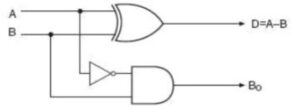
The Half Subtractor circuit can be implemented using one XOR gate and one AND gate with an inverted input.
Logical Diagram:
Binary Full Subtractor
A Half Subtractor can only subtract two single-bit numbers and cannot handle a borrow from a previous stage. Therefore, a Full Subtractor is used for multi-bit binary subtraction. A Full Subtractor performs subtraction between:
- Minuend (A)
- Subtrahend (B)
- Borrow Input (Bin)
Block Diagram:
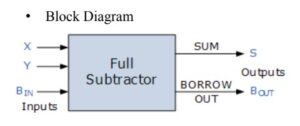
It produces:
- Difference (D)
- Borrow Output (Bout)
Truth Table of Full Subtractor
| A | B | Bin | D | Bout |
|---|---|---|---|---|
| 0 | 0 | 0 | 0 | 0 |
| 0 | 0 | 1 | 1 | 1 |
| 0 | 1 | 0 | 1 | 1 |
| 0 | 1 | 1 | 0 | 1 |
| 1 | 0 | 0 | 1 | 0 |
| 1 | 0 | 1 | 0 | 0 |
| 1 | 1 | 0 | 0 | 0 |
| 1 | 1 | 1 | 1 | 1 |
Boolean Expressions
Difference:
:contentReference[oaicite:2]{index=2}
Borrow Output:
:contentReference[oaicite:3]{index=3}
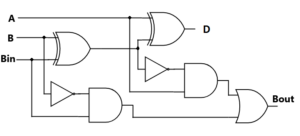
The Full Subtractor is implemented using logic gates and is commonly used in digital arithmetic circuits.
Logical Diagram:
Binary Subtraction
Binary subtraction is the process of subtracting one binary number from another. Unlike a binary adder, which generates a Sum and Carry, a binary subtractor generates a Difference and Borrow. The basic rules of binary subtraction are:
| Operation | Result |
|---|---|
| 0 – 0 | 0 |
| 1 – 0 | 1 |
| 1 – 1 | 0 |
| 0 – 1 | Borrow Required |
n-Bit Binary Subtractor
For practical applications, multiple Full Subtractors are connected in series to form an n-bit subtractor. An n-bit binary subtractor can subtract two multi-bit binary numbers by cascading several Full Subtractor circuits. Binary subtraction can also be performed using the Two’s Complement method. In this method:
- The bits of the subtrahend are inverted using NOT gates.
- A logic 1 is added to form the Two’s Complement.
- The operation becomes binary addition.
This technique simplifies hardware implementation in digital systems.
Advantages of Binary Subtractor
- Simple circuit design and implementation.
- Reduces power consumption in digital signal processing systems.
- Performs arithmetic operations quickly.
- Essential component of digital computing systems.
Disadvantages of Binary Subtractor
- A Half Subtractor cannot accept a borrow input from a previous stage.
- Circuit speed is limited by propagation delay.
- Complexity increases with larger bit sizes.
Applications of Binary Subtractor
- Arithmetic Logic Unit (ALU)
- Central Processing Unit (CPU)
- Electronic Calculators
- Digital Counters
- Timers
- Program Counters
- Digital Signal Processing (DSP) Systems
- Computer Arithmetic Operations
Conclusion
A Binary Subtractor is a fundamental digital circuit used to perform subtraction operations in electronic systems. Half Subtractors and Full Subtractors form the basis of arithmetic operations in computers, calculators, DSP systems, and microprocessors. Their ability to efficiently perform binary subtraction makes them an essential component of modern digital electronics.